
In March 2023, Sir David Evennett asked for more disadvantaged young people to reach higher-level apprenticeships and better-paid jobs. In the same debate, Alison McGovern challenged the Government's assumption that taking any job would set someone on a path to higher earnings. The dispute concerned what would turn an opening into a lasting improvement in someone's life.
Other Commons contributors locate barriers in recruitment, the supply of good local jobs and class prejudice after someone qualifies. The familiar promise of opportunity brings together speakers who diagnose different problems and propose different remedies.
On 10 October, the Guardian reported Alan Milburn's proposal for a national pre-apprenticeship route in England. A separate scheme has opened: from 1 October 2026, eligible employers in England who do not pay the apprenticeship levy can receive £2,000 for recruiting a new apprentice aged 16–24. The funding rules apply to eligible starts on or after 1 October, provided the apprentice joined the employer within the previous three months. Those developments bring a longstanding parliamentary question back into focus: which barrier does a new route remove, and what remains on the other side?
This article was prepared by VoxPolitica Editorial using a blend of human research, VoxPolitica's databases, and an AI research agent that uses the VoxPolitica API to analyse parliamentary data. If you'd like to commission in-depth research to support your work, contact us.
The parliamentary record
VoxPolitica's search for “social mobility” returns 891 contributions across 466 debates and 327 speakers between 13 December 2019 and 12 October 2026.
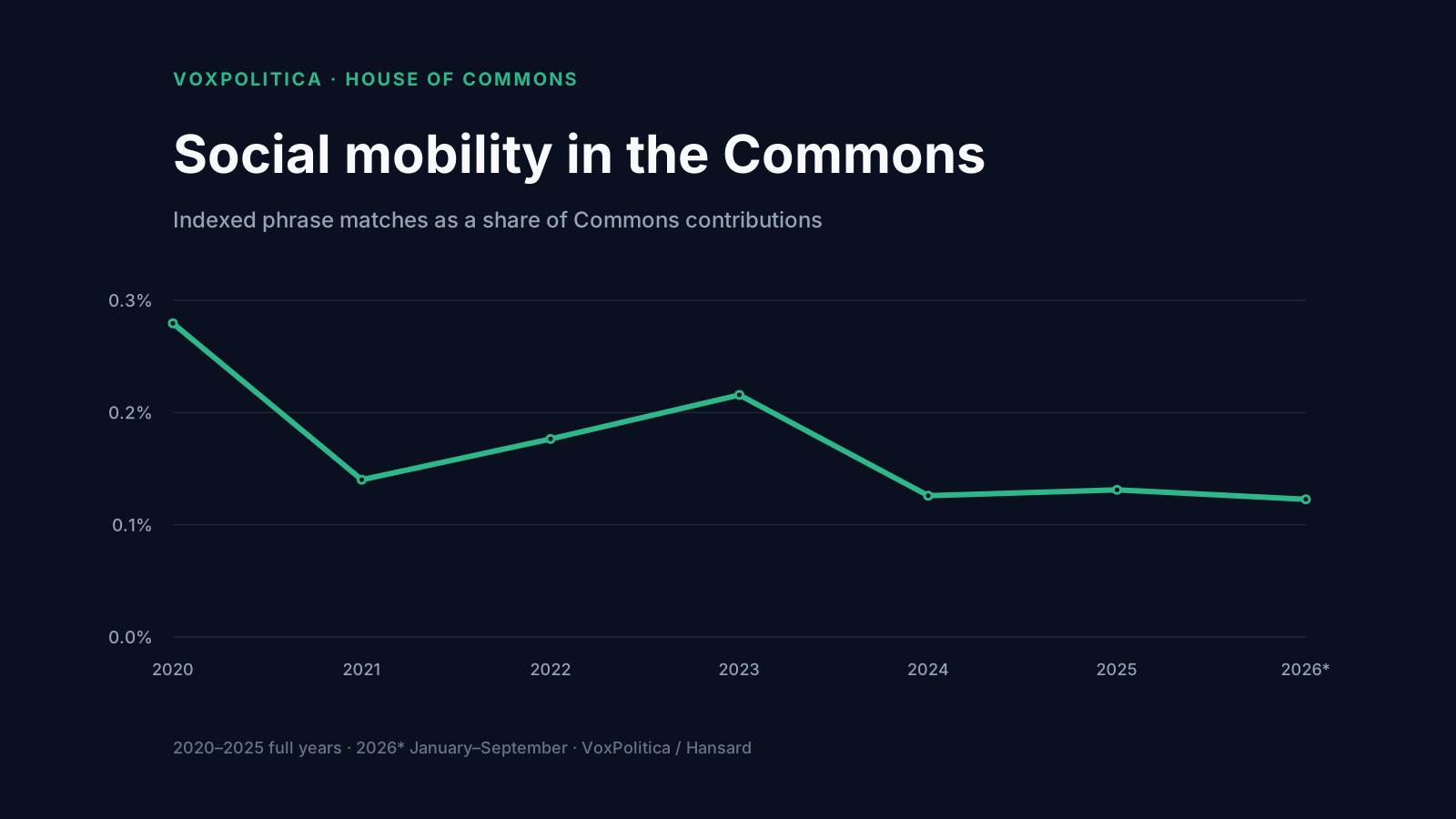
Activity varied over time, with individual debates contributing to the totals. Evennett's February 2020 social-mobility debate accounted for 29 of that month's 68 matches; July 2026's regional-accents debate supplied 23 of 28.
- Rank 1Sir David Evennett
- Contributions
- 27
- Debates
- 16
- Active dates
- 16
Initiated the leading social-mobility debates in February 2020 and March 2023.
Example contribution in Hansard - Rank 2David Johnston
- Contributions
- 24
- Debates
- 21
- Active dates
- 20
Former charity leader and APPG chair; the period also includes later ministerial service.
Example contribution in Hansard - Rank 2Michelle Donelan
- Contributions
- 24
- Debates
- 13
- Active dates
- 12
Includes education-minister replies; multiple interventions can belong to one speech.
Example contribution in Hansard - Rank 4Mims Davies
- Contributions
- 22
- Debates
- 12
- Active dates
- 12
Includes DWP and equalities replies, and later opposition contributions.
Example contribution in Hansard - Rank 5Jon Trickett
- Contributions
- 15
- Debates
- 14
- Active dates
- 14
Repeated arguments about class, poverty and structural economic change.
Example contribution in Hansard - Rank 5Elizabeth Truss
- Contributions
- 15
- Debates
- 9
- Active dates
- 9
Includes replies as Minister for Women and Equalities; volume reflects that role.
Example contribution in Hansard - Rank 7Mrs Kemi Badenoch
- Contributions
- 14
- Debates
- 8
- Active dates
- 7
Includes ministerial equalities answers; counts do not show endorsement of a remedy.
Example contribution in Hansard - Rank 8Peter Aldous
- Contributions
- 10
- Debates
- 9
- Active dates
- 9
Contributions connect further education, coastal communities and opportunity.
Example contribution in Hansard - Rank 8Emma Hardy
- Contributions
- 10
- Debates
- 8
- Active dates
- 8
Includes opposition education scrutiny and apprenticeship-funding arguments.
Example contribution in Hansard - Rank 8Jim Shannon
- Contributions
- 10
- Debates
- 5
- Active dates
- 5
Includes multiple interventions in scheduled social-mobility debates.
Example contribution in Hansard
Includes former MPs and ministerial replies. A speech interrupted by interventions can produce several contributions. Frequency is not a measure of influence or agreement.
The arguments, contribution by contribution
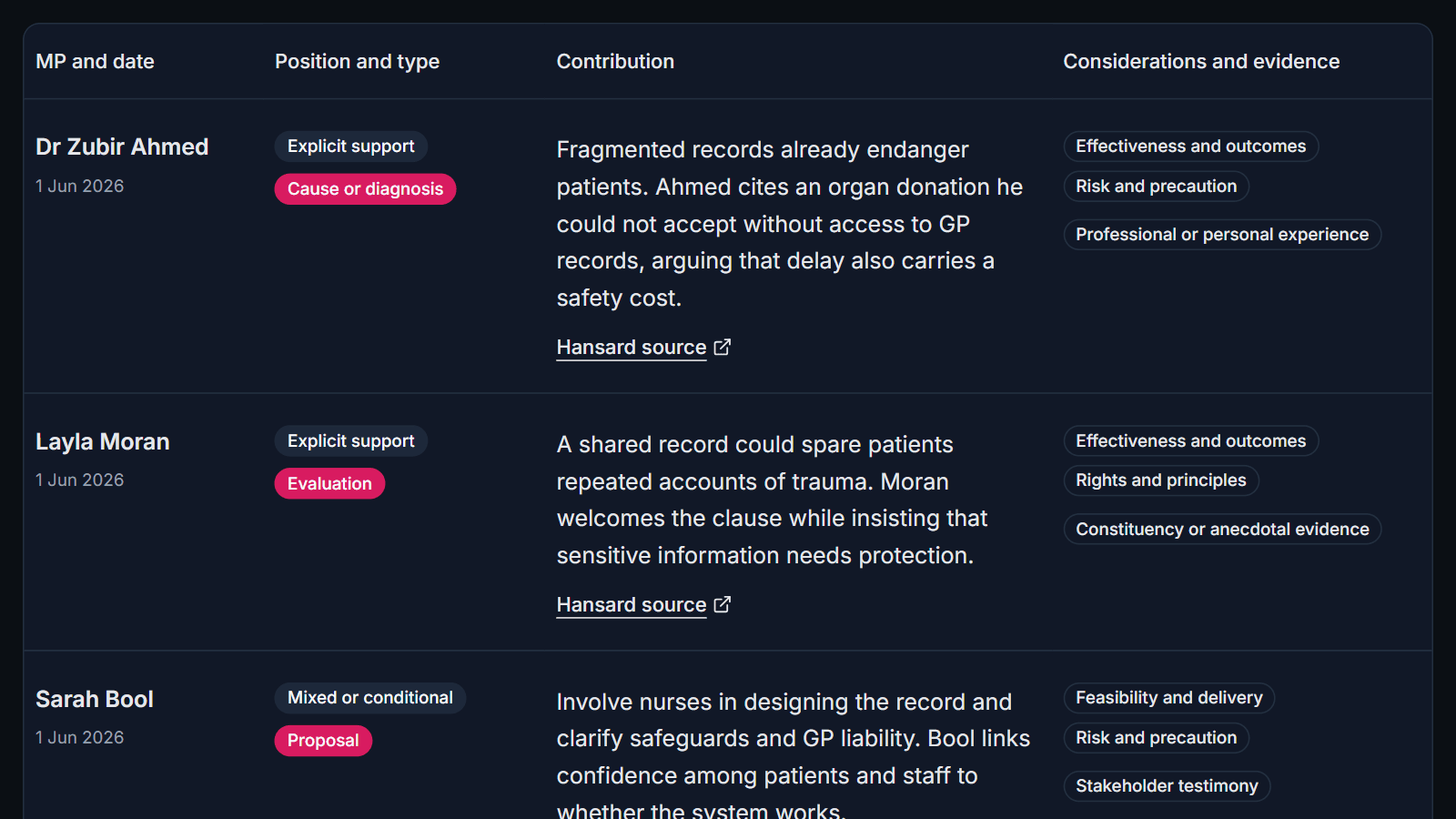
The map below compares twenty contributions against a concrete employment objective: widening access to better-paid work for people from disadvantaged backgrounds. This is our comparison frame, rather than a motion put to all the speakers. It separates an argument's function from the policy consideration it raises and the evidence its speaker invokes. “Explicit support” requires advocacy linked to that employment outcome. “Not established” means the contribution does not state a position on that precise objective, even where it clearly supports apprenticeships, educational access or action against inequality.
Read the rows as a range of arguments and replies, rather than a poll of MPs. They expose different mechanisms: affordability while learning, access to elite institutions, the allocation of apprenticeship funding, recruitment networks, local job supply and progression after recruitment. An earlier argument for apprenticeships does not establish support for the new October proposal.
- Scope
- Better-paid employment as a social-mobility objective; no stance on the October 2026 proposals is inferred. · UK Government; employers and education providers where specified. · England; devolved examples used as comparisons. · Commons record, 13 December 2019–12 October 2026.
- Corpus
- Twenty illustrative contributions selected from the complete 891-match Commons search, 13 December 2019–12 October 2026. Each was checked with the surrounding debate.
Functions, policy considerations and stated evidence are separate classifications. Explicit support requires advocacy linked to better-paid employment for disadvantaged people. Not established means the contribution does not state a position on this precise objective; a wider educational or equality argument can still be definite. The selection illustrates variety, not prevalence or party support. Cited evidence is what the speaker invoked.
Evennett links apprenticeships to stable, skilled, well-paid jobs: earning while learning helps people who cannot afford the living costs of university. He also calls for better-funded colleges and employer partnerships.
Hardy supports apprenticeships but argues that levy design favours training existing, already qualified staff at the expense of entry routes for young people. She asks for guaranteed young-apprentice funding and a separate non-levy budget.
Trott argues that selective university access matters because prestigious employers recruit from a restricted set of institutions. Her remedy is earlier guidance and school preparation, alongside widening university participation.
Peacock asks for investment in education, manufacturing and transport so that former coalfield communities offer secure, better-paid jobs. She treats being forced to leave the area as a consequence of missing local opportunity.
Madders identifies informal recruitment networks and unpaid internships as barriers before a career begins. He advocates open recruitment and a cross-government approach covering work, welfare, housing, transport and health.
Donelan defends targeted access to high-quality apprenticeships and wider higher-education access as routes out of disadvantage. In the preceding exchange she says the Government has not set a target for improving the international mobility ranking.
Evennett argues that progression to higher-paying jobs should accompany entry into work. He proposes employer-school links, careers advice, higher-level apprenticeship access and more open recruitment.
Trickett calls social mobility a myth unless accompanied by massive structural and transformative change. His account of poverty despite work and constrained educational chances challenges the underlying promise, rather than asking only for better delivery.
Johnston places responsibility on employers as well as schools and universities to open elite professions. He also supports moving jobs and investment into disadvantaged areas, while defending access to universities and careers elsewhere.
McGovern challenges the assumption that taking any job leads to better pay or escapes poverty. She calls for action on socioeconomic inequality and questions what targets and data will make government accountable.
Davies defends progression support and acknowledges hardship despite long working hours. After McGovern asks for evidence, she promises further information on Kickstart impact work. Her earlier reply cites skills, confidence and networks as the rationale for taking a first job.
Ranger widens the objective beyond a few young people reaching elite careers: getting a local job after parental unemployment also counts. He proposes earlier careers learning, essential skills, mentoring and worthwhile work experience.
Brackenridge argues that pupils who do not know professionals lack exposure and connections, not talent. She wants careers learning from primary school onwards and a dedicated adviser linking each school to local employers.
Gilmour describes a practical access gap: sparse sixth-form provision and unreliable transport make education and guidance hard to reach. She supports local STEM mentoring, without specifying the better-paid employment objective.
Platt champions apprenticeships from her own experience while arguing that poverty, transport and discrimination still block opportunity. Careers education and a successful qualification cannot on their own secure a fair outcome.
In the accent debate, Platt argues that listeners can use accent as a proxy for class and competence. Drawing on her apprenticeship experience, she urges people to challenge their own biases. This establishes an argument against accent prejudice, rather than a wider employment-policy position.
Malhotra supports changing institutional behaviour and says the Government will work to commence the socioeconomic duty for public bodies. She links accent prejudice with race and gender and defends access based on merit rather than conformity.
Wilson warns that technical pathways without equal funding and esteem can narrow disadvantaged children’s options too early. She asks whether pupils can move between academic and technical routes and whether reform will be funded.
Thompson endorses degree apprenticeships as a route to social mobility, drawing on his engineering teaching experience. His question asks what role they will have in the new education system.
Morgan diagnoses a rural opportunity gap involving underfunded services, poor transport and slow digital connections. Her contribution concerns the infrastructure supporting opportunity, without specifying a position on the scoped employment objective.
Education opens routes, but which routes?
Evennett's February 2020 argument connected apprenticeship access with the need to earn while learning. Living costs could make university difficult for the young people he wanted to reach. His proposed remedy involved better-funded further education colleges, employers working with schools, and teachers presenting apprenticeships as a serious choice.
Laura Trott emphasised a different educational gate in the same debate: access to selective universities. She argued that prestigious employers recruit from a limited set of institutions. Raising the number who attend university would therefore leave a problem if disadvantaged students could not reach those institutions. Her account of comprehensive schooling, Oxford and Sutton Trust support gave that argument a personal basis.
These were different routes to occupational opportunity within the Conservative benches. Donelan, replying for the Government, supported both. She defended targeted apprenticeship access while accepting Trott's point about which universities disadvantaged applicants entered. Asked by Justin Madders whether the Government would set a target for improving its international social-mobility ranking, she said it had not yet done so.
The funding design itself could undermine the route. In the apprenticeship-levy debate a day earlier, Emma Hardy supported degree apprenticeships and workforce retraining but argued that the system favoured existing, already qualified employees over young entrants. She asked for guaranteed funding for younger apprentices and a separate non-levy budget. Her objection concerned who received scarce training resources, not whether apprenticeships could improve someone's prospects.
The same question of whose options widen returned in September 2026. Munira Wilson warned that technical pathways without equal funding and esteem could narrow disadvantaged children's choices too early. She asked whether pupils could move between academic and technical routes. In that statement's exchanges, Adam Thompson endorsed degree apprenticeships from his engineering teaching experience. Neither contribution settles the design of Milburn's proposed route; together they identify a test for any expansion: whether it adds a choice that remains open and credible.
A first job is a disputed mechanism
McGovern's March 2023 challenge addressed the DWP sequence of “any job, better job, career”. She argued that work did not necessarily remove poverty and that an initial job did not necessarily lead to better pay. Her demand was for policies against socioeconomic inequality, clear data and targets, rather than an assumption that recruitment itself would produce progression.
Davies, the minister replying, explicitly disagreed. She cited local organisations' accounts of the skills, confidence and networks gained through an initial job. That was the Government's stated rationale for the first step.
McGovern then asked for evidence of the policy's efficacy to be placed in the Commons Library. In her reply, Davies said work on the impact of Kickstart was under way and promised further information. She also acknowledged that people could work very long hours and still struggle to make ends meet, pointing to jobcentre progression leads and employer partnerships. The exchange records a challenge to the policy and a defence of its intended mechanism; it does not demonstrate that the approach delivered higher earnings.
Trickett challenged the premise more fundamentally. Drawing on his own route from manual work through further education to university, he called social mobility a myth unless accompanied by “massive structural and transformative change”. He combined local poverty and educational disadvantage in his diagnosis. His own mobility did not persuade him that the route was available on comparable terms to a child growing up in his constituency. That condition challenges the assumptions of the prevailing approach; it is more than a request to improve its delivery.
Opportunity can be too far away
Stephanie Peacock's 2020 contribution connected Barnsley's opportunities with deindustrialisation and the loss of higher-paying local jobs. She sought investment in skills, manufacturing and transport so that a better career would not require leaving the area. Education was part of the remedy, but so was the local economy into which it led.
In his March 2023 contribution, Johnston explicitly supported both moving jobs and investment into disadvantaged areas and widening access to elite universities and professions elsewhere. He distributed responsibility across employers, schools, universities and other institutions: schools could not open professions on their own.
For Rachel Gilmour, speaking in June 2025, the immediate constraint was reaching post-16 provision and careers guidance at all. She described long journeys and unreliable public transport in Tiverton and Minehead. Helen Morgan's September 2026 rural-services argument similarly placed transport, digital connections and public-service capacity inside the diagnosis of unequal opportunity.
Those accounts test a preparation programme differently from an argument about low attainment. A place on a course or an apprenticeship offers limited practical access if the person cannot get there. An employer incentive does not itself provide a bus service or create the wider range of local occupations Peacock sought.
Andrew Ranger also questioned which movement should count. He wanted shorter moves into local employment after parental unemployment recognised alongside access to elite careers. His proposed earlier careers learning, mentoring and work experience pursued that broader objective. Even the destination of a successful social-mobility policy was being contested.
Qualifications do not change who gets heard
Madders's 2020 diagnosis identified recruitment networks and unpaid internships as barriers at the entrance to a profession. Careers information would be of limited use if access depended on personal connections or the ability to work without pay. He wanted open recruitment and a government approach extending beyond the education department.
By July 2026, Jo Platt was locating another barrier inside selection and progression. She described softening her accent while a marketing apprentice and argued that listeners could mistake class signals for competence. In that debate, she urged listeners to challenge their own biases. The argument puts scrutiny on those making judgments about accents; it does not establish her position on a wider employment programme.
Platt's position also frustrates a neat divide between advocates of training and advocates of structural change. In the previous year's careers debate, she praised apprenticeships from her own experience while saying education alone could not remove poverty, discrimination and poor connectivity. Evennett, meanwhile, had advocated more open recruitment alongside college investment. The mechanisms cross party boundaries without making the speakers' diagnoses identical.
Replying to the accent debate, Seema Malhotra said the Government would work to commence the socioeconomic duty in section 1 of the Equality Act. That was a commitment concerning public bodies' strategic decisions. It should not be read as a statement that a new statutory ban on accent discrimination was already in force.
The new hiring payment has a concrete early checkpoint. Government guidance provides two £1,000 instalments, at day 90 and day 365, or day 242 for apprenticeships lasting under twelve months; the earliest payment is due in January 2027. Training providers claim the payments and pass them to employers. The first milestone asks whether the apprenticeship has lasted long enough for payment. The Commons arguments set a longer test: who gets through the entrance, whether they can sustain the route, and whether the work it leads to offers better prospects.
VoxPolitica analysis of the House of Commons corpus, including Westminster Hall, retrieved on 13 October 2026 for 13 December 2019–12 October 2026. The complete Professional Filter Tool search uses the quoted phrase “social mobility”, with no MP or party restriction. English full-text indexing includes stemmed wording and debate titles as well as speech; counts retain procedural contributions and incidental matches, and are not a count of every argument about disadvantage. Trends supplies the same-period all-Commons denominator. The headline line uses full years 2020–2025 and January–September 2026; monthly boundary periods are labelled. MP rankings count contributions, retain former members and ministerial replies, and give equal counts equal rank. Chart and ranking data are available to download. The twenty-row argument analysis is a purposive illustration using taxonomy 1.0.0, not an estimate of argument prevalence or party support. MPs' cited evidence is distinguished from independently verified fact. October policy context was checked against the linked reporting and government guidance on 13 October.
View exact annual chart data
* 2026 covers January–September. Partial December 2019 and October 2026 are excluded from this line. Counts include procedural and title-only matches. They measure recorded activity, not support or policy effectiveness.