The Government has changed who will handle rent disputes without changing the underlying affordability benchmark. Under plans announced on 9 September, HMRC’s Valuation Office will make initial decisions when English tenants challenge an increase. For now, those challenges still go to the First-tier Tribunal. In either system, the test is the market rent—not whether the new figure is affordable on the tenant’s income.
The average private rent in England reached £1,459 a month in August 2026, 4.0% higher than a year earlier. The latest annual affordability measure puts an average-priced English tenancy at 36.3% of median private-renter household income in 2024, and 41.6% in London. The Renters’ Rights Act has ended section 21, limited increases to once a year and given tenants two months’ notice and a route to challenge an above-market demand. It does not regulate the market level itself.
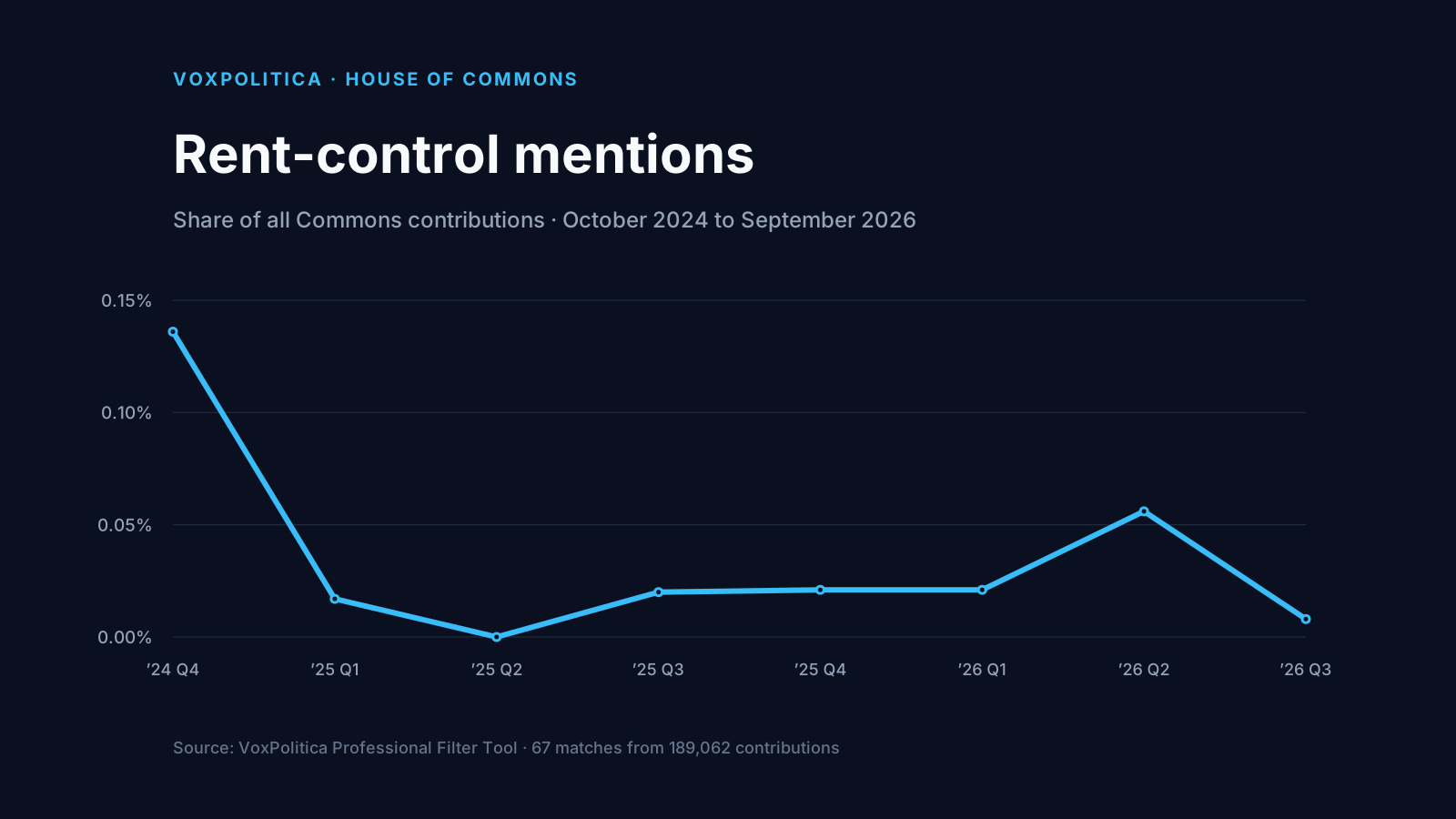
VoxPolitica reviewed 67 Commons contributions that explicitly used “rent control” or “rent controls”. MPs pressing for controls described sudden increases used as an eviction, rents outrunning wages, Local Housing Allowance subsidising the market and retrofit costs passed to tenants. Ministers and Conservative MPs focused on people seeking a home: would controls protect an incumbent tenant at the expense of mobility, investment or supply?
Labour MPs are on both sides of the dispute. Housing minister Matthew Pennycook has used the phrase most often because he repeatedly answered questions for the Government. Backbenchers including Nadia Whittome, Dan Carden, Apsana Begum and John McDonnell have argued for controls of one form or another. Green MPs have offered the most detailed pro-control designs. Later proposals are more local and specific than the broad demands heard at the start of the Renters’ Rights Bill, but ministers still oppose them.
This article was prepared by VoxPolitica Editorial using a blend of human research, VoxPolitica's databases, and an AI research agent that uses the VoxPolitica API to analyse parliamentary data. If you'd like to commission in-depth research to support your work, contact us.
View chart data
- 2024 Q4
- Matches35All contributions25,772Share0.136%
- 2025 Q1
- Matches6All contributions35,165Share0.017%
- 2025 Q2
- Matches0All contributions28,884Share0.000%
- 2025 Q3
- Matches3All contributions14,900Share0.020%
- 2025 Q4
- Matches5All contributions24,035Share0.021%
- 2026 Q1
- Matches6All contributions28,854Share0.021%
- 2026 Q2
- Matches11All contributions19,561Share0.056%
- 2026 Q3
- Matches1All contributions11,891Share0.008%
Source: VoxPolitica analysis of 189,062 House of Commons contributions, 1 October 2024 to 30 September 2026. The exact-phrase query matched 67 contributions. Frequency measures activity in the defined record, not support for rent controls or public opinion.
The Bill produced the peak, not a settlement
The exact phrase appeared in 67 contributions from 23 MPs across 33 debates between 5 July 2024 and 4 October 2026. Thirty-five came in October and November 2024, when the Renters’ Rights Bill had its Second Reading and early committee sittings. A smaller return in spring 2026 included Dan Carden’s direct question about the evidential basis for government policy.
No single debate supplied more than eight contributions, but participation was still concentrated by role. Pennycook made 18 contributions across 12 debates and 10 dates. Carla Denyer followed with 11 across seven debates; Jeremy Corbyn had five across four; Whittome four across four; and Carden four across three. Pennycook’s count records ministerial scrutiny and replies, not advocacy. Denyer’s is sustained backbench pressure through the Bill, devolution legislation and questions on other policies.
12 debates · 10 active dates
7 debates · 6 active dates
4 debates · 4 active dates
4 debates · 4 active dates
3 debates · 3 active dates
Speaking frequency establishes recorded activity, not support, expertise or influence. Matthew Pennycook’s total is shaped by his housing-minister role.
The series measures explicit Commons activity, not support. It also understates the wider affordability discussion: an MP can call for a “rent freeze”, a cap on increases or stronger Local Housing Allowance without using the phrase. The narrow wording makes the population behind the ranking stable and auditable.
The disagreement is over which renter gets protected
At Second Reading on 9 October 2024, Denyer set out two policies that are often collapsed into one label. She proposed an in-tenancy increase cap at the lower of wage growth or inflation to stop a landlord pricing out a sitting tenant. She also wanted locally flexible controls designed to bring rents down relative to incomes. The first is a security measure. The second attempts to change affordability at the market level.
Apsana Begum put the security case in its bluntest form: a 20% increase can operate as a no-fault eviction under another name. Whittome later added the public-finance argument, linking rising rents both to a larger share of wages and to the housing-benefit bill. Corbyn joined those points in September 2026. He argued that repeatedly raising Local Housing Allowance chases the market and proposed a rent ceiling alongside benefit relief. His intervention came while 2026-27 LHA rates remained at the cash levels first set in April 2024.
Pennycook accepts the premise that an extortionate increase can force someone out. His remedy is the Act’s procedural restraint: one increase a year, two months’ notice and a challenge against the local market rent. His objection to a numerical cap originally rested on two asserted mechanisms. Landlords might lift rents routinely to the maximum even when they would otherwise have left them unchanged; others might sell or withhold investment, leaving fewer homes to rent.
By April 2026 he had added a distributional objection. In answer to Carden, Pennycook said controls tend to help settled and better-off tenants more than people looking for a home or needing to move. That formulation concedes that some tenants gain. The ministerial case is that the gain is uneven and can be purchased at the expense of outsiders to the controlled tenancy.
Carla DenyerGreen
Support: in-tenancy cap plus locally flexible controls
Separate protection against sharp increases from the wider aim of bringing rents down relative to incomes.
Apsana BegumLabour
Support: constrain sharp increases
A 20% rise can operate as a no-fault eviction under another name.
Jeremy CorbynYour Party
Support: rent ceiling alongside LHA relief
Uprating housing support alone chases the market and leaves claimants meeting shortfalls from other income.
Dan CardenLabour
Support: deprived-area pilot
Low purchase prices and poor stock can coexist with high room rents, making a Liverpool fair-rent pilot worth testing.
Carla DenyerGreen
Support: controls alongside efficiency rules
Prevent required retrofit costs being transferred straight to tenants through higher rents.
Angela RaynerLabour · Government
Oppose: use challenge rights and a bidding ban
Direct controls are said to restrict rental supply.
Matthew PennycookLabour · Government
Oppose: retain market-rent adjudication
A numerical cap may prompt landlords to raise rents routinely to the maximum.
Matthew PennycookLabour · Government
Oppose: across the design spectrum
Controls are said to favour settled, better-off tenants over movers and households seeking a home.
Supporters focus on the tenant already paying a high rent or facing a sharp increase. Opponents focus on the next tenant, the household that needs to move and the home that may not reach the rental market. The challenge process does not resolve that trade-off. It makes market rent the boundary between an unreasonable and a permissible increase.
Later proposals focus on local powers
The pro-control case became more specific after the Bill’s opening stages. In January 2025, McDonnell asked for mayors to receive the power to introduce controls where needed. In September, Denyer cited Bristol city council’s cross-party request to pilot them; Bell Ribeiro-Addy asked for the same power for metro mayors. Siân Berry later proposed that strategic authorities should be able to request such powers through the devolution framework.
Carden supplied a different geographic case in February 2026. In parts of Liverpool, he argued, a landlord can buy a low-priced terraced house, split it into rooms and charge rents that bear little relation to the purchase price or the condition of the property. He asked ministers to test a fair-rent model in deprived areas with poor housing stock. Andrew George paired controls with tax incentives for landlords offering decent homes at lower rents. Denyer’s January question on the Warm Homes Plan proposed controls for another purpose: preventing the cost of required energy improvements being passed straight to renters.
A London- or Bristol-wide affordability rule, an in-tenancy cap, a Liverpool pilot and a restriction on retrofit pass-through would cover different properties and change different incentives. Later contributions became more specific about design, but they do not show that Commons support grew. Only five exact-phrase contributions came after the Act took effect on 1 May 2026.
The party picture is equally uneven. Green MPs consistently advocate controls but emphasise local flexibility and complementary social housing. Labour ministers oppose both controls and rent stabilisation; Labour backbenchers supply most of the case for pilots, devolution and the link with benefits. Jeremy Corbyn argues for a national ceiling, while George’s single Liberal Democrat contribution combines a control with incentives. Conservative contributions chiefly invoke supply and Scotland. Kemi Badenoch’s April 2026 reference was an attack on reported Treasury interest rather than a worked policy argument.
Scotland proves less than either side says
Scotland dominates the Commons evidence fight. Pennycook, Angela Rayner and Sir James Cleverly cite it as a warning about supply and rising rents. Denyer and other supporters argue that emergency, in-tenancy controls were partial and unstable, and that a policy covering increases between tenancies could behave differently.
Scottish Government and ONS rent series have historically relied heavily on advertised or new-let rents. They do not capture a lower rent retained by an incumbent tenant whose increase was capped. During the October 2024 bill evidence sessions, the witness Anna Evans made the same distinction: advertised rents rose after the emergency legislation, but the data did not establish the average rent across sitting and new tenancies. Scotland’s new framework allows ministers to designate local control areas after council assessments and would apply a cap during and between tenancies. The first local reports are due by May 2027, so that model has not yet produced the outcome evidence MPs seek.
A natural experiment following San Francisco’s 1994 expansion of rent control found that covered tenants were less likely to be displaced and became less mobile. It also found that affected landlords reduced rental supply by selling or redeveloping properties. One city under one design therefore produced both an incumbent benefit and an access cost. The study cannot predict the balance from a Bristol pilot, a nationwide cap tied to wages or a limit on retrofit pass-through in England.
Ministers cite that uncertainty when defending market-linked initial rents and annual increases. Supporters use it to argue for narrower trials. The proposals have become more precise; the disagreement remains.
A faster challenge still uses market rent
The Valuation Office proposal may make challenges quicker and less intimidating. The national “Register your rental property” service will also begin its regional rollout in the West Midlands on 15 December, giving councils new information for enforcement. Neither policy changes the affordability test. A tenant can defeat an increase above the market rate and still face one that absorbs an unsustainable share of household income.
Ministers have regulated how and when rents rise, and removed eviction without a statutory ground. They have declined to regulate the market price because they judge access and supply to be the greater risk. Their critics increasingly propose local pilots and tailored caps rather than one national freeze. The new challenge service will show whether easier disputes change landlord demands or tenant behaviour. Local property data may then allow Parliament to compare security for a sitting tenant with access for the next one.
VoxPolitica searched all House of Commons contributions from 5 July 2024 to 4 October 2026 through its typed Professional Filter Tool for the exact phrases “rent control” or “rent controls”. The complete result contained 67 contributions from 195,853 Commons contributions. The chart uses eight full quarters from October 2024 to September 2026: 67 matches from 189,062 contributions. The argument register is illustrative close reading of 13 source-linked records selected after all 67 matches were reviewed; it is not an estimate of argument prevalence. Current policy and statistics were checked against GOV.UK’s Renters’ Rights guidance, the 9 September announcement, the ONS September 2026 rent release, the ONS affordability bulletin, VOA’s 2026-27 LHA tables, Scottish Government rent data and policy pages, and Diamond, McQuade and Qian’s 2019 San Francisco study. Research cut-off: 4 October 2026.