Campaign organisations published an open letter on 8 October drawing on an analysis by Tania Tirraoro of Special Needs Jungle identifying 20 ways in which the proposed SEND reforms could reduce legal protections. The linked Parliament petition had more than 114,000 signatures in its 10 October data snapshot and closes on 14 October. It has crossed the threshold at which the Petitions Committee will consider it for debate, but no debate has been scheduled.
The campaign’s charge is broader than “EHCPs are being abolished”, which the proposal does not do. The decisive change is an eligibility rule: in future, only a child or young person assessed as needing the overall support in a nationally defined Specialist Provision Package would be entitled to an Education, Health and Care Plan. Other children with identified SEND would receive school- or college-led Individual Support Plans, backed by new duties and a larger mainstream offer. The Commons dispute is whether that exchange can deliver help sooner without removing the enforceable individual route that families use when provision fails.
This article was prepared by VoxPolitica Editorial using a blend of human research, VoxPolitica's databases, and an AI research agent that uses the VoxPolitica API to analyse parliamentary data. If you'd like to commission in-depth research to support your work, contact us.
The proposed bargain: less dependence on a plan, a narrower route to one
The Department for Education consultation describes four layers: a universal offer, targeted support, targeted-plus support and specialist provision. National Inclusion Standards would define what settings should ordinarily provide. A £1.6 billion Inclusive Mainstream Fund over three years and a £1.8 billion “Experts at Hand” programme are meant to give schools access to educational psychologists, speech and language therapists and other specialists without waiting for a statutory assessment.
At the specialist layer, a national expert panel would define roughly seven packages. A local authority assessment would decide whether a child needs the overall support in one or more of them. If so, the child would receive an EHCP securing the relevant package offer. Detailed day-to-day provision would sit in an Individual Support Plan developed by the setting with the family. If the child did not meet the package threshold, support would instead be recorded in an ISP and there would be no EHCP.
That distinction creates three different legal questions which are often collapsed into one.
First, who receives the local-authority assessment and crosses the package threshold? The consultation says the current assessment route will be reformed and that parents can appeal a refusal to assess or a decision that no Specialist Provision Package is needed. It does not yet define the package eligibility criteria which that appeal would test.
Second, what is enforceable after the assessment? For an EHCP holder, the setting would have a legal duty to deliver the educational offer in the package, while the ISP would hold the more detailed daily provision. Settings would have statutory duties to identify and meet needs and produce ISPs; the consultation also says they would monitor progress to ensure timely and effective intervention and be responsible for delivering educational provision. The unresolved issue is how families could enforce particular provision recorded in an ISP. The consultation routes disputes about its content or delivery through school complaints, Ofsted oversight and a possible independent SEND role rather than giving the ISP content a separate tribunal appeal.
Third, what can the tribunal order? Access would remain for refusal to assess, package entitlement, package type and decisions to amend or cease an EHCP. On placement, however, the proposal would let the tribunal quash the local authority’s decision and require it to decide again, rather than name the school or setting itself. Separate appeals about the description of special educational need or detailed educational provision would also change because that detail would move into the ISP.
The Government calls this a stronger system because more children would receive support under duties that do not depend on winning an EHCP. The campaign calls it a rights reduction because the individual document, its specified provision and some independent remedies would cover fewer decisions. Both descriptions refer to real parts of the proposal.
Parliament’s EHCP attention peaked before the White Paper
VoxPolitica’s complete measurement search found 756 Commons contributions from 239 MPs across 187 debates between 5 July 2024 and 10 October 2026. Each contribution explicitly used “EHCP”, “EHCPs”, “education health and care plan” or the plural. They represented 0.39% of all 195,853 Commons contributions in the same period.
View exact chart data
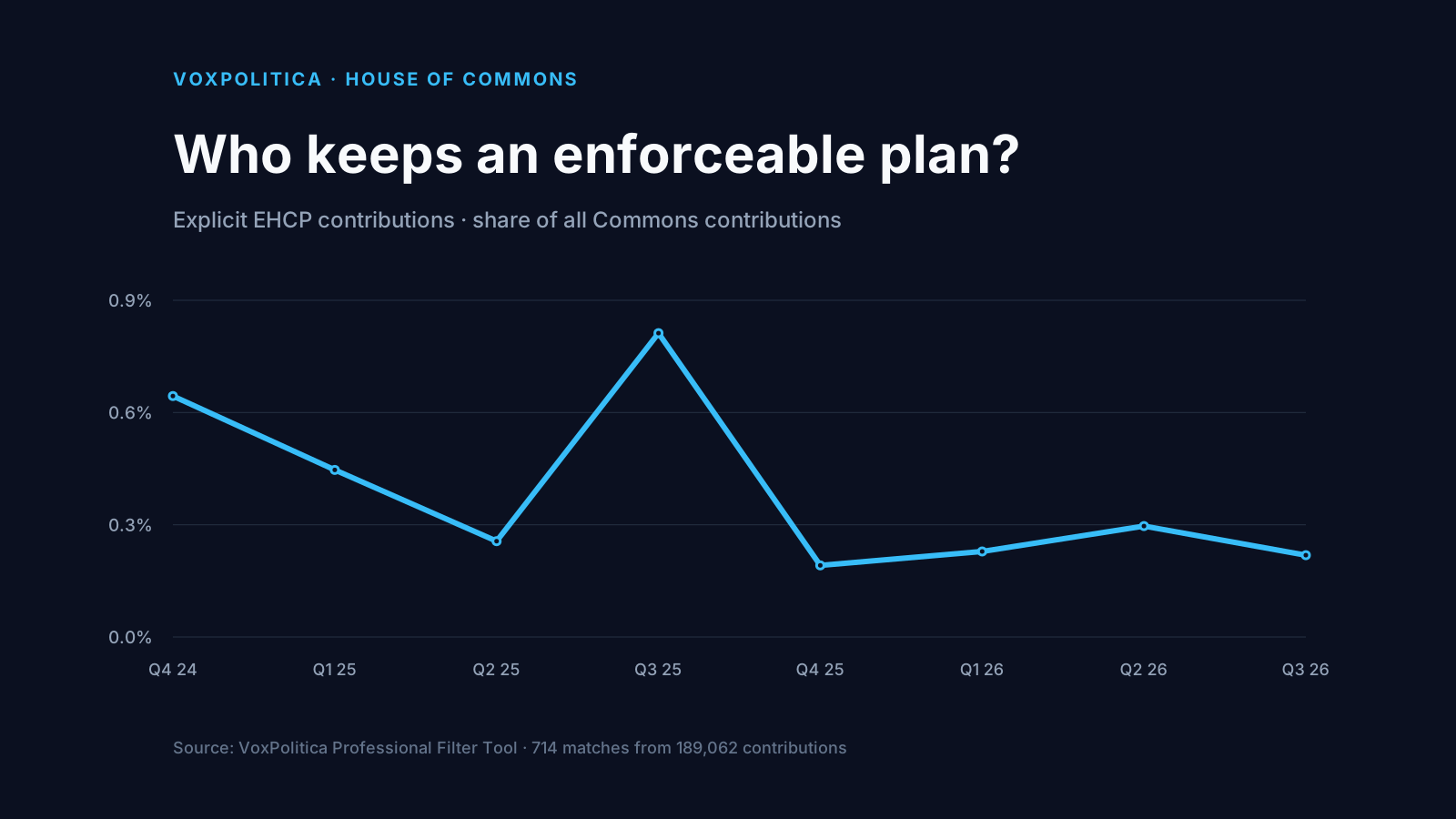
The series measures explicit recorded activity, not support for any position. Q3 2024 and Q4 2026 are excluded because they are partial boundary quarters.
Across the eight complete quarters from October 2024 to September 2026, the terms appeared in 714 of 189,062 contributions. The high point was July to September 2025: 121 of 14,900 contributions, or 0.812%. Fifty came in the 15 September debate on assessments and support. The quarter containing the February 2026 White Paper was much lower at 66 of 28,854, or 0.229%.
This is an activity series, not a measure of support. It also deliberately excludes SEND speech that never uses an EHCP term. What it establishes is that the current campaign arrived after two earlier bursts of explicit Commons attention: late 2024 and the debates of 2025.
No single debate or speaker dominates the full population. The largest debate supplied 59 of 756 contributions, 7.8%. Catherine McKinnell was the leading speaker with 36, 4.76%, spread across 23 debates and 20 dates. Her total reflects a ministerial answering role for much of the period. Bridget Phillipson’s 22 contributions were concentrated into seven debates and six dates for the same reason. Munira Wilson’s 24 across 17 debates record sustained Liberal Democrat scrutiny rather than government replies.
- 1Catherine McKinnellLabour36 contributions23 debates20 dates
Ministerial answering role during much of the period
- 2Munira WilsonLiberal Democrat24 contributions17 debates17 dates
Backbench and party education scrutiny
- 3Bridget PhillipsonLabour22 contributions7 debates6 dates
Secretary of State answering and making statements
- 4Mark FrancoisConservative19 contributions8 debates8 dates
Repeated constituency and system scrutiny
- 5Gregory StaffordConservative16 contributions11 debates11 dates
Backbench scrutiny, including the April reform debate
- 6Ben Obese-JectyConservative13 contributions11 debates11 dates
Repeated questions across distinct debates
- 7James WildConservative13 contributions8 debates8 dates
Repeated constituency and funding scrutiny
- 8Marie GoldmanLiberal Democrat12 contributions5 debates5 dates
Concentrated contributions in five debates
- 9Helen HayesLabour11 contributions8 debates8 dates
Education Committee chair during the reform debate
- 10Jen CraftLabour11 contributions8 debates8 dates
Backbench scrutiny across eight debates
Counts reflect both scrutiny and replies. Catherine McKinnell and Bridget Phillipson rank highly in part because of ministerial answering roles; frequency is not a measure of support, influence or expertise.
The breadth matters. Gregory Stafford, who secured the main April reform debate, ranks fifth rather than first. Helen Hayes and Jen Craft each appear in eight debates. Ben Obese-Jecty contributed on 11 separate dates. The ranking therefore identifies MPs most present in the explicit EHCP record, but it does not treat ministerial frequency as advocacy or backbench repetition as influence.
The Commons argument: four tests for the package threshold
The 13 April SEND Provision and Reform debate is the clearest parliamentary test of the White Paper. It contained 32 explicit-EHCP contributions from 21 MPs. VoxPolitica reviewed all 32 in context, together with the three proposition-relevant contributions in the February launch statement, then classified 17 distinct contributions for publication.
The proposition is deliberately narrower than the campaign letter: should entitlement to an EHCP depend on needing the overall support in a nationally defined Specialist Provision Package? That wording separates the eligibility decision from disputes about a particular package, placement or EOTAS arrangement.
Four tests recur in the contribution-level record.
1. Is legal entitlement useful if the system cannot deliver it?
Chris Vince, drawing on his work as a teacher, challenged the idea that statutory wording had protected children when schools lacked the staff or resources to supply what a plan required. Daniel Francis, who declared both family experience of an EHCP and his wife’s work as a SENCO, supported ISPs and Experts at Hand because a child should not wait one or two years for a less complex plan to be updated.
That is the strongest government-side argument. A legal plan obtained late can be less valuable than speech therapy, educational psychology or adaptive teaching delivered early as part of the normal system. Its implicit comparison is not a functioning EHCP against an ISP. It is today’s delayed and under-delivered EHCP against a funded local offer that acts before needs escalate.
The reply, made by Gregory Stafford, is that the new model depends on precisely the school, CAMHS and specialist capacity which is currently missing. If the capacity is not built first, removing the individual route for some children does not produce earlier help; it transfers assessment, provision and conflict to the setting least equipped to absorb it.
2. Does national consistency protect children or flatten individual need?
The Government presents national packages as an answer to the postcode lottery. A comparable need should produce a comparable offer, commissioned locally but defined by evidence rather than by each council’s finances and practice. Sarah Smith praised the White Paper for treating the system as a whole and offering a “more consistent, earlier, clearer and fairer” route.
John Glen put the counterargument more carefully than a simple defence of the status quo. He accepted the fiscal pressure created by rapidly rising plan numbers, but warned that a shift from individual statutory entitlement to “nationally determined fixed packages” could create another enforceability gap. Saqib Bhatti gave the Opposition condition: reform must enshrine parental rights and cannot become a one-size-fits-all settlement. That condition does not by itself establish that Bhatti rejects the package threshold.
This disagreement cannot be resolved until the packages exist in enough detail to test. Laura Trott welcomed evidence-led packages and earlier support on launch day but said Parliament did not know what the packages contained, who qualified or how much funding accompanied each. The proposal promises nationally consistent breadth; the legal and practical issue is how far an EHCP can still select and specify provision for the individual within that breadth.
3. Where does accountability sit when an ISP fails?
This is a recurring concern among the selected conditional contributions. Ben Coleman welcomed the investment, the new plans and the retained tribunal route for complex need, then asked for a clear legal resolution when a school does not deliver an ISP. He later floated an ombudsman with binding powers. Jen Craft argued that earlier help was essential because unmet need grows, but asked how a parent could make a school comply.
Helen Hayes’s distinction was equally important. More trained teachers and faster specialist input are the right direction; replacing a statutory plan with an ISP which is not itself on the same statutory footing leaves no settled answer when need is misidentified, the plan is inadequate or its contents are not implemented.
The Government’s answer is system accountability: statutory duties on settings, Ofsted and CQC scrutiny, stronger complaints, an independent role and department-level action against failing local authorities. Critics ask for individual enforceability: a remedy a family can invoke in the child’s own case. An inspectorate can identify systemic failure without necessarily compelling tomorrow’s missing therapy session. The final design must show how those two forms of accountability meet.
4. Is the tribunal a last resort or the only effective backstop?
Ashley Dalton described a constituent whose son received an appropriate school only because enforceable rights and the tribunal’s power to name a placement overcame the local authority’s decision. Cameron Thomas gave two similar constituent cases. Their point is not that tribunal should be the normal way to secure education; it is that a last resort must be capable of changing the result.
Ministers agree that tribunal remains necessary, but want mediation and complaints to solve more disputes earlier. The proposal retains appeals about assessment and package entitlement. Its placement remedy is weaker in one precise respect: the tribunal could require the local authority to decide again, but not substitute its own named setting. That may reduce direct judicial control while preserving formal review. Whether it is still an effective backstop depends on what happens when the authority repeats a disputed decision.
- Scope
- The proposed England SEND model in which only children and young people needing the overall support in a Specialist Provision Package receive an EHCP, while less complex needs are supported through school-level Individual Support Plans and the wider mainstream offer. · UK Government · England · Proposal published on 23 February 2026 and parliamentary record reviewed through 10 October 2026.
- Corpus
- Seventeen illustrative contributions were selected after full review of the 32 explicit-EHCP contributions in the 13 April reform debate and three proposition-relevant contributions from the 23 February White Paper statement.
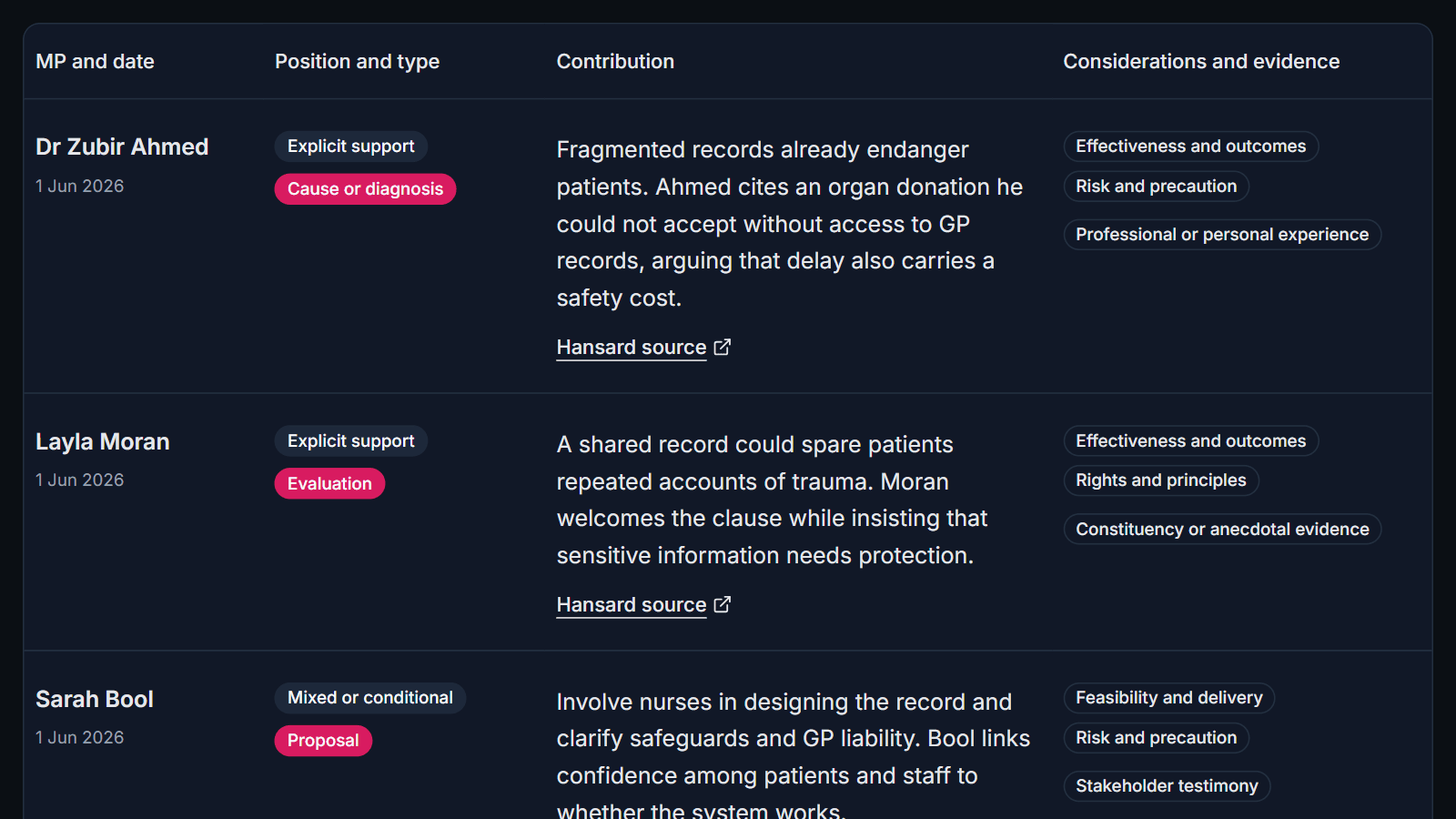
Each row is a distinct, full-context contribution coded against the same proposition. The table shows argument variety, not how common each argument was.
Replacing an enforceable EHCP route with ISPs for some children risks exchanging a slow legal guarantee for a simpler but weaker remedy.
The central question is whether individual support plans will carry those same enforceable rights.
Legal wording does not itself secure provision when schools lack capacity; a model resembling one he had seen work could be more effective.
Whether it was a legal requirement or not, those schools were just not able to provide it.
The delivery model assumes NHS and school capacity that does not yet exist and may transfer both provision and dispute burdens to schools.
By moving away from a clearly defined, legally enforceable EHCP framework towards individual support plans, much of the responsibility for decision making—and, inevitably, dispute resolution—risks being pushed on to schools.
He supports enforceability but argues that a legal framework which is routinely delayed or overturned is not delivering the promised outcome.
But he also recognises that EHCPs are not coming through at the level they should within the 20 weeks—certainly, it is about the 10% level—so having the legal backing and framework is not delivering the outcome.
Moving some children from statutory plans to setting-level ISPs leaves unresolved who can compel correction when needs are misidentified, plans are inadequate or provision is not delivered.
The concern is about how accountability will be guaranteed if there are problems with the ISP, if their child’s needs are not correctly identified, if the ISP that is drafted is not fit for purpose or if it is not being implemented properly.
She supports reform only if an EHCP or equivalent enforceable route remains for those who need it and families do not lose the means to compel provision.
My constituent agrees with the Government that the system we inherited is not working, and she is not asking us to scrap these reforms, but we must ensure that the changes we are making to an unfair system support SEND children and their families as much as we possibly can.
The investment and new support model are welcome, but parents need a clear legal route when a school does not deliver an ISP.
If a school fails to deliver what is written in a child’s individual support plan, I do think parents need a clear legal route to resolution.
A whole-system roadmap built around earlier, consistent mainstream expertise offers a route out of the existing postcode lottery, although local-authority accountability remains necessary.
A more consistent, earlier, clearer and fairer system is within reach.
Tribunal-backed enforceability must survive because it was the mechanism through which two constituents obtained plans and placements.
Does the right hon. Gentleman agree with me that any reforms to the process must be enforceable?
The state must confront rising demand honestly, but moving from individual statutory entitlements to fixed packages risks reproducing the same unmet expectations with a new enforceability gap.
It seems to me that the representatives of those with unmet SEND provision and the charities are concerned that having set expectations in our country that EHCPs are legally enforceable, there will be an enforceability gap.
ISPs and Experts at Hand can deliver earlier support without waiting for a less complex plan to be updated, provided health accountability, professional support and transition are resolved.
I support the proposals because there are issues that we can put right, such as with Experts at Hand.
Earlier intervention is necessary because unmet need escalates, but reform cannot work unless parents have clear recourse when schools or councils fail to act.
There needs to be accountability in the system.
Any reform must keep parental rights in law and avoid replacing individual protections with a one-size-fits-all package.
The Conservative position is clear: any reforms that come forward must enshrine parental rights in law and the Government must not water down those rights.
The package model is intended to end the need to fight for an EHCP by building support into mainstream provision, while retaining EHCPs and tribunal review for those who need specialist packages.
Critically, education, health and care plans will remain, and they will be available for children who need them.
National mainstream support, Experts at Hand and statutory ISPs should provide help earlier, leaving EHCPs derived from specialist packages for the most complex needs.
This is about improving support, not removing support.
She welcomes early and evidence-led support in principle but says undefined package eligibility, school workload and funding make the proposal impossible to judge.
We do not know exactly how children will qualify for an EHCP in the future, and no clear eligibility criteria for the so-called specialist provision are set out.
ISPs alongside EHCPs are welcome only if parents receive an enforceable legal right to education under the new plans.
What assurances can the Secretary of State give parents that we will genuinely enforce the legal right to an education with these new plans?
The table reveals why a binary “keep or scrap EHCPs” frame is inadequate. Government supporters argue that legal entitlement without capacity is a paper promise. Opponents argue that capacity without an individual remedy is an administrative promise. The uncertain and conditional rows ask whether both can be built: support that arrives without litigation, plus a route strong enough to work when ordinary delivery fails.
Stakeholder map: most selected positions remain unresolved
The selected map contains two clear supporters of the proposition, two opponents and eight uncertain positions. That is not an estimate of the House and should not be read as one. It maps what 12 significant participants said in the launch statement and the principal scrutiny debate.
- Scope
- The proposed England SEND model in which only children and young people needing the overall support in a Specialist Provision Package receive an EHCP, while less complex needs are supported through school-level Individual Support Plans and the wider mainstream offer. · UK Government · England · Proposal published on 23 February 2026 and parliamentary record reviewed through 10 October 2026.
- Corpus
- Twelve MPs were selected from the White Paper statement and the principal reform debate to represent explicit support, opposition and unresolved positions.
A position is classified only when the cited contribution settles this exact proposition. General support for reform or a question about safeguards remains uncertain.
This map classifies what MPs said in the parliamentary record about the stated proposition. It does not claim to identify their underlying thoughts, beliefs, motives or attitudes. Positions may be conditional, time-bound or changed by later contributions.
Presented package-derived EHCPs for the most complex needs as one layer in a wider system of earlier mainstream support.
- Said the model was under consultation and promised a phased transition from 2030.
- Launched the reform and explicitly linked EHCPs for the most complex needs to specialist provision packages.
Children with the most complex needs will still have access to education, health and care plans derived from a specialist provision package of support designed by experts.
23 Feb 2026Hansard source
Defended a system in which mainstream duties meet more needs without an EHCP while plans and tribunal access remain for children assessed as needing them.
- Promised transition safeguards and said consultation responses could change the design.
- Argued that earlier provision would reduce the need to fight for a plan while retaining an assessed statutory route.
Critically, education, health and care plans will remain, and they will be available for children who need them.
13 Apr 2026Hansard source
Supported the proposals and their earlier-support model, but did not address whether EHCP entitlement should depend on needing an entire Specialist Provision Package.
- Required stronger health accountability, workforce support and careful transition.
Uncertainty: General support for the proposals does not establish a position on the precise package-based eligibility threshold.
- Supported the proposals on early-intervention grounds while naming three delivery concerns, without isolating the EHCP threshold.
I support the proposals because there are issues that we can put right, such as with Experts at Hand.
13 Apr 2026Hansard source
Rejected the claim that an EHCP’s legal status is sufficient and defended the White Paper’s delivery logic, but did not settle the exact package-based threshold.
- His intervention did not address every proposed change to appeal or placement rights.
Uncertainty: Disagreeing with criticism of the White Paper does not establish endorsement of this specific eligibility rule.
- Argued that legal plans had not overcome school capacity constraints.
Whether it was a legal requirement or not, those schools were just not able to provide it.
13 Apr 2026Hansard source
Argued that shifting children from EHCPs to ISPs would weaken enforceability and move unsupported legal and emotional burdens to schools.
- Accepted that the Government intended to improve the system and that the present model is not working well.
- Made legal protection his first test and said the proposed assurance was absent.
The central question is whether individual support plans will carry those same enforceable rights.
13 Apr 2026Hansard source
Opposed moving from individual statutory entitlements to resource-led fixed packages because he expected an enforceability gap.
- Also argued that Parliament must confront the fiscal consequences of rapidly rising EHCP demand.
- Combined a fiscal constraint with a warning that fixed packages would not solve unmet statutory expectations.
It seems to me that the representatives of those with unmet SEND provision and the charities are concerned that having set expectations in our country that EHCPs are legally enforceable, there will be an enforceability gap.
13 Apr 2026Hansard source
Required reform to preserve parental rights in law and rejected a one-size-fits-all approach, without saying whether the package threshold necessarily breached that condition.
- Supported reform in principle and asked the Minister to provide reassurance rather than rejecting every element.
Uncertainty: The contribution states a rights condition but does not accept or reject the proposition itself.
- Made preservation of parental rights a condition of reform without resolving the eligibility threshold.
The Conservative position is clear: any reforms that come forward must enshrine parental rights in law and the Government must not water down those rights.
13 Apr 2026Hansard source
Supported more expertise and faster help but challenged replacing some statutory plans with setting-level ISPs before accountability was settled.
- Her Committee had not yet completed its scrutiny of the specific proposals at the date of the contribution.
Uncertainty: The contribution identifies risks but does not say whether she rejects the package threshold if those risks are resolved.
- Reported a concrete accountability objection while endorsing early specialist support.
The concern is about how accountability will be guaranteed if there are problems with the ISP, if their child’s needs are not correctly identified, if the ISP that is drafted is not fit for purpose or if it is not being implemented properly.
13 Apr 2026Hansard source
Backed reform while asking for an EHCP or similar enforceable route for those who need it and no weakening of families’ ability to secure provision.
- Her case focused particularly on tribunal power over placements.
Uncertainty: She did not define which children could properly move from an EHCP to an ISP once an enforceable backstop existed.
- Used a placement case to make enforceability a condition of acceptable reform.
My constituent agrees with the Government that the system we inherited is not working, and she is not asking us to scrap these reforms, but we must ensure that the changes we are making to an unfair system support SEND children and their families as much as we possibly can.
13 Apr 2026Hansard source
Welcomed the investment, ISPs and retained EHCP route but required a clear legal remedy when ISP provision was not delivered.
- Later in the same speech he suggested an ombudsman with binding powers as a possible backstop.
Uncertainty: He did not say whether the EHCP threshold itself should stand once an ISP enforcement route was added.
- Welcomed the model but made enforceability an unresolved condition.
If a school fails to deliver what is written in a child’s individual support plan, I do think parents need a clear legal route to resolution.
13 Apr 2026Hansard source
Welcomed the reform principles but withheld judgment because package eligibility, ISP triggers, workload and funding were unspecified.
- Her response was delivered on publication day before detailed implementation or consultation feedback.
Uncertainty: She supported the principles but did not accept or reject the proposition without the missing design detail.
- Said the lack of eligibility and funding detail prevented an assessment of effectiveness.
We do not know exactly how children will qualify for an EHCP in the future, and no clear eligibility criteria for the so-called specialist provision are set out.
23 Feb 2026Hansard source
Welcomed ISPs alongside EHCPs but asked whether the legal right to education would genuinely be enforceable under the new plans.
- His contribution was a question rather than a settled endorsement of the eligibility threshold.
Uncertainty: A request for assurance is not enough to classify him for or against the package-based threshold.
- Combined a welcome for ISPs with an unresolved legal-rights test.
What assurances can the Secretary of State give parents that we will genuinely enforce the legal right to an education with these new plans?
23 Feb 2026Hansard source
The Government position is coherent. Bridget Phillipson launched the package threshold and Georgia Gould defended the model against the April objections. Daniel Francis and Chris Vince supplied experience-based reasons why earlier support might outperform a plan that cannot be delivered, but neither cited contribution settles whether EHCP entitlement should depend on needing an entire package. They are therefore uncertain on this proposition despite their support for the reform’s overall direction.
Opposition is not simply a defence of the existing system. Stafford accepts the need for reform and Glen makes the fiscal constraint explicit, but both reject moving to the proposed package-and-ISP settlement without an individually enforceable backstop. Bhatti conditions reform on retaining parental rights; because he does not say whether the threshold necessarily fails that test, his position on the exact proposition remains uncertain.
The eight uncertain cards identify unresolved design conditions. Francis and Vince support the reform’s delivery logic without isolating the threshold. Bhatti sets a rights test without saying whether the proposal can pass it. Hayes, Dalton and Coleman endorse major parts of the reform but do not settle the eligibility question without a stronger remedy. Trott says undefined packages prevent judgment, while Mark Sewards welcomes ISPs alongside EHCPs yet asks whether the legal right will actually be enforceable. These are unresolved recorded positions, not views inferred from party labels.
The Education Committee had already taken a stronger institutional position. Paragraph 93 of its September 2025 Solving the SEND Crisis report recommended that the Department’s reforms “must not be based on any withdrawal of statutory entitlements” and should instead increase accountability across the system. That does not establish opposition to every possible package arrangement, but it is more than a sequencing recommendation. In April, Hayes applied the accountability concern to ISPs while stopping short of accepting or rejecting the exact package threshold; that is why she is uncertain in both the contribution table and stakeholder map.
The campaign’s 20 claims extend beyond the Commons proposition
The open letter is useful because it itemises rather than generalises. Its 20 claimed reductions cover at least five separate groups: access to assessment; individual specification of provision; the duty to secure every item; parental participation and preference; and appeal powers over need, provision, placement and EOTAS. Some concern the package threshold analysed here. Others concern what an EHCP contains after a child qualifies or what a tribunal can order.
That separation matters for evaluating the Government response. Saying that EHCPs and tribunal access remain does not answer whether fewer children receive a plan, whether detailed provision moves to a less directly appealable ISP, or whether the tribunal’s placement remedy changes. Conversely, describing the whole programme as the removal of legal rights omits the proposed statutory duties on settings, national standards and the retained appeal over assessment and package entitlement.
The campaign also supports much of the reform’s stated objective: more inclusive mainstream education, earlier identification, workforce training, access to specialists and provision that does not require a diagnosis. Its disagreement is over the claimed necessity of trading current individual protections for that investment. This is why the most useful test is not whether either side wants earlier help. Both say it does. The test is whether the Government can specify an individual entitlement and an effective remedy for the children who will no longer have an EHCP.
What happens before 14 October—and after it
The 12-week consultation closed on 18 May. The consultation status page says the Government is reviewing responses and will set out its response and next steps. No final consultation response had been published by the 11 October research cut-off. The current legal system remains in force. New-system assessments are proposed from September 2029; changes to support received through existing EHCPs would begin no earlier than September 2030, with transition generally occurring at educational phase boundaries. Children and young people holding a special-school place in September 2029 would be able to remain in special school until the end of their education unless they chose to move to a mainstream setting.
The petition closes on 14 October, but crossing 100,000 signatures guarantees consideration for a debate, not a debate date or a change of policy. Its immediate effect is therefore political: it raises the cost of leaving the threshold, ISP remedy and tribunal powers undefined in the Government’s response.
The Commons record suggests a route by which ministers could narrow the dispute. Define package eligibility before asking Parliament to legislate. State which ISP provisions are individually enforceable and by whom. Explain what binding remedy follows a failed complaint. Show that health and school capacity will exist before children are moved out of current entitlements. Preserve a tribunal power capable of ending, not merely recycling, an unlawful placement decision.
Those tests do not preserve a system which MPs across the House describe as broken. They decide whether reform replaces the fight for a plan with reliable provision—or simply moves the fight to a weaker document.
VoxPolitica searched all House of Commons contributions from 5 July 2024 to 10 October 2026 through its typed Professional Filter Tool for “EHCP”, “EHCPs”, “education health and care plan” or “education health and care plans”. The complete population contained 756 contributions from 239 MPs across 187 debates, from 195,853 Commons contributions. The trend uses eight complete quarters from October 2024 to September 2026: 714 matches from 189,062 contributions. The argument table is an illustrative close reading of 17 distinct records selected after all 32 matches in the 13 April reform debate and three relevant 23 February statement contributions were reviewed in full context; it is not an estimate of argument prevalence. The stakeholder map applies the same stated proposition to 12 MPs and preserves unresolved positions. Current policy and status were checked against the Department for Education consultation, its status page, the Parliament petition data, the Education Committee’s Solving the SEND Crisis report, and the campaign’s open letter. Research cut-off: 11 October 2026; Commons data cut-off: 10 October 2026.