Commons debates on the single patient record focus on its benefits and who should have access to patient data.
The Health Bill received its Lords second reading on 13 October. Its patient-record provisions would enable existing health and social care information to be linked and shared with patients and those caring for them in England.
VoxPolitica has mapped 24 Commons contributions setting out the benefits MPs expect and their arguments over access, safeguards and delivery.
This article was prepared by VoxPolitica Editorial using a blend of human research, VoxPolitica's databases, and an AI research agent that uses the VoxPolitica API to analyse parliamentary data. If you'd like to commission in-depth research to support your work, contact us.
Contributions over time
Across the year to 14 October, 159 contributions from 53 MPs across 27 debate sections matched the single-patient-record search, after excluding oral-evidence hearings and procedural amendment readings. 134 of those contributions fell in June and July, encompassing second reading and committee scrutiny.
View exact monthly chart data
- Jan 2026
- 0.000% · 0/10,994
- Feb 2026
- 0.037% · 3/8,147
- Mar 2026
- 0.010% · 1/9,713
- Apr 2026
- 0.030% · 2/6,641
- May 2026
- 0.043% · 1/2,329
- Jun 2026
- 0.548% · 58/10,591
- Jul 2026
- 1.317% · 76/5,772
- Aug 2026
- No recorded denominator
- Sept 2026
- 0.278% · 17/6,119
- Oct 2026 (to 14th)
- 0.045% · 1/2,205
* October ends on the 14th. August is a gap. Denominators include all indexed Commons records, including hearings and procedural contributions. Counts measure recorded activity, not support.
July's matches represented 1.32% of all indexed Commons contributions, compared with 0.55% in June. Yet July involved just ten matched speakers, against forty in June. The 2 July afternoon committee sitting alone supplied 49 contributions from nine MPs; second reading on 1 June supplied 47 from 36. The higher July rate describes a concentrated legislative exchange, with repeated interventions and replies, rather than a broader spread of participants.
The Commons argument map
The map separates what a contribution does—propose, diagnose, predict or rebut—from the policy consideration and evidence it invokes. Its proposition is the Government's creation of a linked record for direct care in England. Support for that proposition does not imply support for every part of the Health Bill, a particular supplier or unrestricted secondary use of data.
The rows show the range of recorded arguments, without estimating their prevalence. “Uncertain” preserves questions and requests for assurances whose speakers do not explicitly endorse or reject the precise proposition.
- Scope
- The Health Bill’s enabling framework for a linked direct-care record, including who can access information and how the system is governed. · UK Government and NHS health and social care providers · England; cross-border treatment examined as an implementation boundary. · Commons proceedings, 1 January–14 October 2026
- Corpus
- Twenty-four selected contributions from 1 June to 9 September 2026, drawn from the 159-match non-hearing Commons population. They illustrate arguments and replies; their distribution is not a poll or prevalence estimate.
Each contribution was read in full with surrounding exchanges. Function, policy consideration and stated evidence are separate classifications. Explicit support can include criticism and requests for improvements, unless support is withheld or made conditional. “Mixed or conditional” includes support for shared records alongside rejection of the proposed model. “Uncertain” means the precise proposition is not explicitly endorsed or rejected; a question is not counted as support. “No explicit evidence stated” describes the selected reasoning, not its truth. Historical party labels are omitted.
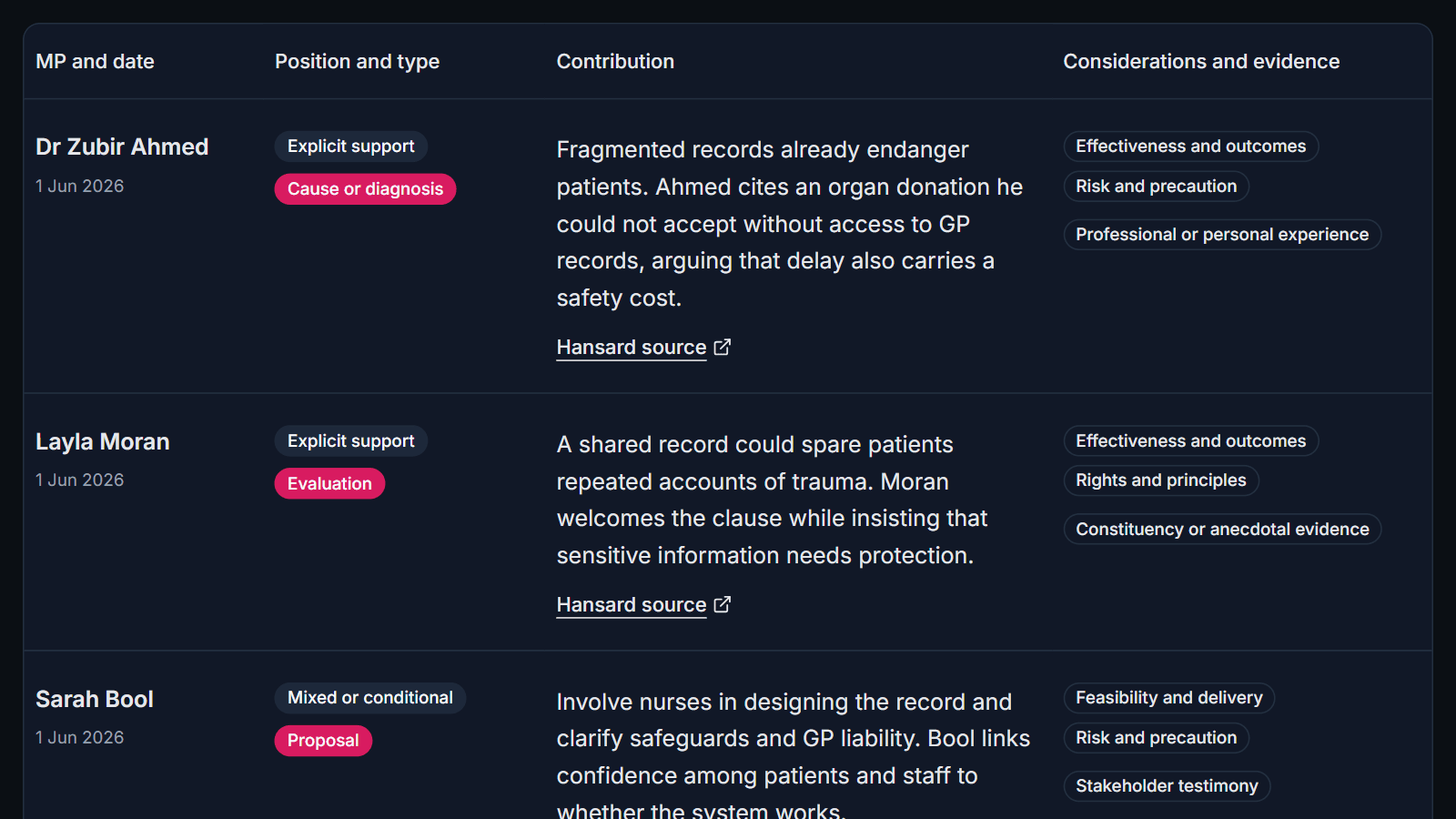
Fragmented records already endanger patients. Ahmed cites an organ donation he could not accept without access to GP records, arguing that delay also carries a safety cost.
A shared record could spare patients repeated accounts of trauma. Moran welcomes the clause while insisting that sensitive information needs protection.
Involve nurses in designing the record and clarify safeguards and GP liability. Bool links confidence among patients and staff to whether the system works.
Build on existing shared records, give patients control and avoid dependence on one supplier. Onwurah asks for national infrastructure safeguards.
Wrigley supports shared clinical records but rejects what he calls an overreaching centralised approach. He argues that existing federated systems could supply the benefits without the proposed relaxation of privacy protections.
The planned record links existing systems while information stays with GPs and trusts. Murray promises authorised access and an audit trail.
Make records follow patients across devolved borders. Minns asks how Carlisle residents registered with Scottish GPs will benefit.
Give carers access to the relevant parts of the record so they can oversee medication and identify errors. Chambers accepts that unrelated historical information need not be shared.
Access needs levels of permission: a carer may need treatment details without seeing an unrelated reproductive history. Johnson questions a simple yes-or-no model of access.
Verify who nominates a carer, protect vulnerable patients from coercion and make consent revocable. Stafford supports the aim but challenges poorly governed access.
The Bill already permits access on a patient's behalf. Smyth intends to include carers and says regulations will specify proxy access, making the amendment unnecessary.
Publish a digital-exclusion risk assessment with patient groups. Morgan supports the record but asks how people without devices, connectivity or digital skills will use it.
Inclusion and public communication are essential, but Smyth says existing assessment and engagement make additional statutory requirements unnecessary.
Johnson accepts the principle but criticises approving a system before its design is settled. She questions record accuracy, the confidentiality override and cybersecurity, and whether delivery costs could outweigh the claimed savings.
Require a published plan against inappropriate access before regulations are laid, covering legitimate care relationships, audit logs, sanctions and investigation.
Use role-based permissions, monitoring and existing enforcement. Smyth argues that regulations will specify safeguards, so a separate advance plan is unnecessary.
An enabling law does not itself make rival record systems exchange data. Joe Robertson wants the record but challenges how suppliers' commercial incentives will be overcome.
Creating an overarching record can force progress on connecting fragmented systems. Dave Robertson argues that the common requirement will help drive interoperability.
Put clear principles and responsibilities for access, liability and redress into the framework. Chambers argues that a health data charter would protect trust and patients' control.
Smyth says existing data-protection law still applies and proposes multiple suppliers, licences and information standards to avoid dependency. She argues that compulsory NHS ownership of connector software could discourage suppliers.
Publish a full outline plan covering links between records, access, control and security. Johnson recognises potential benefits but says the design questions remain unanswered.
Give pharmacies and community mental health services a role in design. Beales supports the record and says the whole health and care system must participate in delivery.
Allow consent-based referrals to approved specialist charities using only necessary information. McDonald seeks a defined route to practical and peer support beyond clinical care.
Extend the record into pharmacy as part of genuinely integrated primary care. Al-Hassan argues that seeing activity across services would also inform funding decisions.
The safety argument runs in both directions
Zubir Ahmed's case at second reading began with the risks of the existing arrangement. He described having to turn down an organ donation in his own clinical practice because GP records could not be accessed at the weekend. For him, leaving records fragmented already exposed patients to harm. That was a clinician's account offered in support of reform, not a measured estimate of how many incidents the proposed system would prevent.
Layla Moran identified a different cost: a constituent described the suffering caused by repeatedly recounting traumatic experiences. Moran welcomed the patient-record clause while warning about sensitive information. Sarah Bool, who described an allergy-related near miss involving a constituent's wife, also asked whether nurses would help design the system and how concerns about GP liability would be answered.
Carers need access with limits
Danny Chambers sought explicit provision for nominated carers, accepting that irrelevant historical information need not be shared. His concern was practical: carers could lack the information needed to understand medication, oversee treatment or identify a mistake.
Caroline Johnson challenged the idea of access as a binary choice. A carer might need current treatment details without being entitled to an elderly patient's reproductive history. Gregory Stafford added questions about consent: who nominates the carer, how is permission checked, can it be withdrawn, and what protects someone pressured into granting access?
Karin Smyth answered that the Bill already allowed information to be made available on a patient's behalf. The Government intended that to include carers, with proxy-access arrangements specified in regulations. Her answer accepted the objective while rejecting the need for Chambers's amendment. It left the operating rules to the next stage of policy design.
The boundary also extends beyond carers. At report stage, Andy McDonald proposed consent-based referral to approved specialist charities, sharing only necessary information. He distinguished practical and peer support after spinal cord injury from clinical care. Danny Beales wanted pharmacies and community mental health services involved in designing the record. In September's pharmacy debate, Sadik Al-Hassan argued for a record extending beyond general practice into pharmacy; Rishi Sunak also backed single records for joined-up primary care. The scope of a useful record depends on which providers can participate.
Geography creates another boundary. Julie Minns asked about Carlisle residents registered with Scottish GPs. Murray confirmed the proposal applied to England and referred to discussions with devolved counterparts. The Bill permits regulations to make the record available to providers treating patients elsewhere in the British Islands, subject to safeguards. That does not itself ensure reciprocal access to records held in devolved systems.
Criticisms of the proposed system
Martin Wrigley challenged the Government's chosen model at second reading. He called the proposed approach an “overreaching centralised system” and argued that existing federated records in Greater Manchester, Merseyside and Shropshire could provide shared clinical access without the proposed legal changes. His criticism concerned the necessity of the new powers and the alternative already available to ministers.
That was Wrigley's characterisation of the proposal. James Murray had described a system linking information that remained with GP practices and hospital trusts, while Smyth said in committee that existing data-protection law would continue to apply. Wrigley explicitly accepted the importance of a single record; his objection was to how the Government proposed to achieve it. Agreement about clinicians seeing relevant information left a dispute about the legal and technical route.
Data-protection law and the common-law duty of confidentiality are separate protections. The Bill allows regulations to lift that duty for specified processing to establish and operate the record or make information available through it. The Government's explanatory notes say this is limited to direct-care purposes, with data-protection law still applying. They state that ministers intend to preserve the confidentiality duties of professionals accessing the record to deliver care, relying on patients' implied consent.
Caroline Johnson questioned how Parliament could approve a system whose design remained unsettled, calling it a “hazy vision in the distance”. She asked who could edit records, how errors would be corrected and how confidentiality and cybersecurity would be protected. She also questioned whether delivery costs could overwhelm the anticipated savings, invoking the earlier NHS IT programme as a warning. Her argument placed the burden on ministers to show that wider access would be accurate, secure and worth the cost before the detailed rules were settled.
Johnson accepted the principle of shared records. Her demand was for decisions and safeguards before the new arrangements proceeded. Her inappropriate-access amendment would have required a published prevention plan before regulations were laid; her report-stage proposal sought a wider outline plan covering links between records, access, control and security. Smyth argued that access rules belonged in regulations and existing enforcement powers were available. The disagreement concerned whether a detailed plan should be a legal precondition for making those regulations.
Joe Robertson's criticism addressed the connection between legislation and delivery. Competing suppliers would still have to make their record systems exchange information. He argued that creating the concept of a single record did not resolve those commercial and technical barriers, while explicitly saying he wanted it delivered.
Dave Robertson argued that an overarching requirement could help force progress. Smyth pointed to common standards, licences and multiple suppliers, rejecting a blanket requirement for NHS ownership of connector software. The exchange exposed a disputed assumption behind the Bill: whether an enabling framework would give the NHS sufficient means to secure working connections between rival systems.
Direct care and other uses also need to remain distinct. The Government's fact sheet says the Bill supplies no new legal gateway for research, planning or commissioning: those uses require a separate existing legal basis. That qualifies any suggestion that a record created for treatment automatically opens information for every other NHS purpose. The existing national data opt-out concerns research and planning; it does not cover information used for an individual's care.
Access for patients without digital access
Helen Morgan's digital-exclusion amendment asked for a risk assessment developed with patient groups, covering devices, connectivity, disability and skills. She explicitly supported the record. Her challenge concerned whether the people it was meant to empower could use it.
Smyth replied that inclusion was essential but existing equality assessment and engagement made another statutory requirement unnecessary. When Morgan pressed her on patients without a device or connection, Smyth acknowledged that broadband and implementation questions still needed work. Agreement about inclusion had not produced a complete account of access for those patients.
- Rank 1Karin Smyth
- Contributions
- 20
- Debate sections
- 10
- Active dates
- 8
Minister replying on safeguards, proxy access and implementation.
Read an example contribution - Rank 2Dr Danny Chambers
- Contributions
- 14
- Debate sections
- 4
- Active dates
- 3
Carer access and a health data charter; nine of 14 matches fall on 2 July.
Read an example contribution - Rank 3Gregory Stafford
- Contributions
- 13
- Debate sections
- 3
- Active dates
- 2
Consent, coercion and privacy; all 13 matches fall on 2 and 9 July.
Read an example contribution - Rank 4Dr Caroline Johnson
- Contributions
- 11
- Debate sections
- 6
- Active dates
- 5
Opposition health spokesperson: access safeguards and a prior outline plan.
Read an example contribution - Rank 5James Murray
- Contributions
- 9
- Debate sections
- 2
- Active dates
- 2
Eight matches at second reading, plus a maternity investigation statement.
Read an example contribution - Rank 5Joe Robertson
- Contributions
- 9
- Debate sections
- 2
- Active dates
- 2
Interoperability and competing suppliers; seven matches in the 2 July afternoon sitting.
Read an example contribution - Rank 7Helen Morgan
- Contributions
- 7
- Debate sections
- 3
- Active dates
- 3
Digital exclusion and patients’ control; recurring scrutiny across three dates.
Read an example contribution - Rank 8Dr Zubir Ahmed
- Contributions
- 5
- Debate sections
- 4
- Active dates
- 4
Clinical risks when records cannot be accessed; activity across four dates.
Read an example contribution - Rank 8Martin Wrigley
- Contributions
- 5
- Debate sections
- 3
- Active dates
- 3
Confidentiality and patients’ control; health-data governance across three dates.
Read an example contribution - Rank 8Sojan Joseph
- Contributions
- 5
- Debate sections
- 2
- Active dates
- 2
Clinical errors, repeated histories and existing privacy safeguards.
Read an example contribution
Includes ministerial replies and split speeches. Frequency identifies activity in this record; it does not measure influence, expertise or agreement.
Smyth leads the activity ranking with 20 contributions across ten debate sections, reflecting her ministerial answering role. Chambers's 14 contributions span four sections, while all 13 of Stafford's matches fall on two July dates.
The Government's stated ambition is access to a core set of patient data through the NHS app from 2028. Lords committee scrutiny is scheduled to begin on 28 October. The Commons exchanges leave peers concrete choices to examine: the detail required before regulations, permissions that patients and carers can understand, and the obligations that make separate systems work together.
VoxPolitica analysis of Commons proceedings, 1 January–14 October 2026, retrieved 15 October and reconciled against a fresh retrieval on 16 October. Professional Filter Tool query: “single patient record”, using indexed text and debate titles. The complete retrieval contained 195 records; 34 from two oral-evidence hearings were excluded because records combine questions and witness answers, alongside two procedural readings. The remaining 159 records supply all activity counts, debate groupings and MP rankings. The monthly denominator is all indexed Commons contributions in the same bounded period, including hearings and procedural records; October ends on the 14th and August has no recorded denominator. These percentages describe activity within the indexed record and are sensitive to the mix of proceedings; they do not measure support. Contribution counts can split interrupted speeches. The 24 argument rows are a purposive, context-reviewed selection, classified with VoxPolitica's political argument taxonomy 1.0.0; they do not establish argument shares or positions inferred from silence. Historical party labels are omitted. Exact chart values are available below the chart, and each argument links to its source contribution. Download the reviewed chart data and rankings.