Labour’s conference promise to remove statutory limits on government share ownership in water companies has reopened an argument that its own Government rejected in April as too slow and complex. Four days later, the Green Party called for Thames Water and South East Water to be brought into public ownership before Christmas, without compensating shareholders or creditors.
The phrase “public control” covers materially different interventions: direct state ownership, customer-owned mutuals, a court-supervised special administration and tougher oversight of a privately owned company. Each puts risk in a different place among customers, taxpayers, shareholders and lenders.
This article was prepared by VoxPolitica Editorial using a blend of human research, VoxPolitica's databases, and an AI research agent that uses the VoxPolitica API to analyse parliamentary data. If you'd like to commission in-depth research to support your work, contact us.
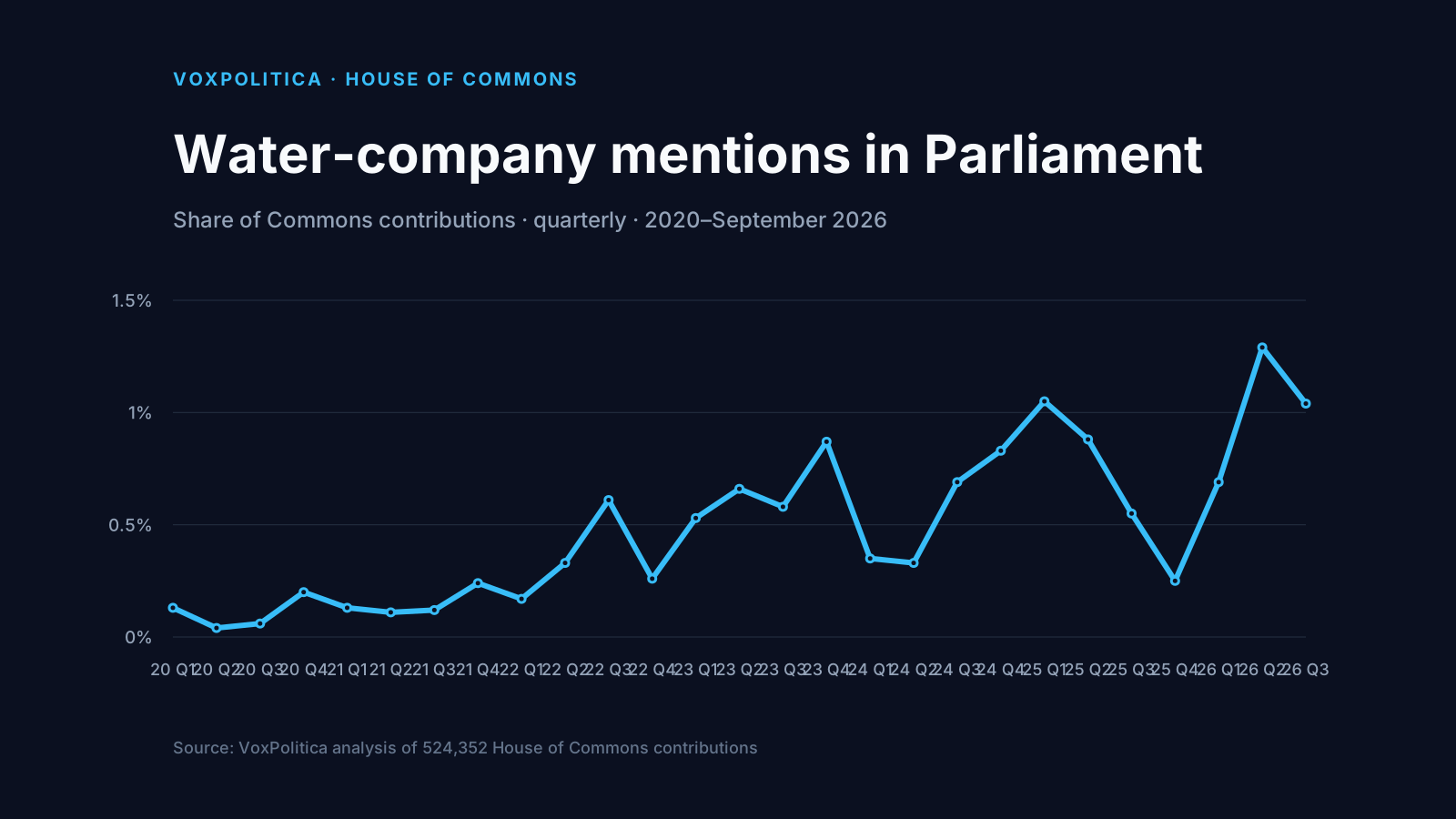
View chart data
- 2020 Q1
- Matches27All contributions21,539Share0.13%
- 2020 Q2
- Matches5All contributions14,117Share0.04%
- 2020 Q3
- Matches8All contributions14,512Share0.06%
- 2020 Q4
- Matches48All contributions24,260Share0.20%
- 2021 Q1
- Matches22All contributions16,392Share0.13%
- 2021 Q2
- Matches18All contributions16,251Share0.11%
- 2021 Q3
- Matches19All contributions15,844Share0.12%
- 2021 Q4
- Matches55All contributions22,896Share0.24%
- 2022 Q1
- Matches43All contributions24,929Share0.17%
- 2022 Q2
- Matches60All contributions18,305Share0.33%
- 2022 Q3
- Matches65All contributions10,652Share0.61%
- 2022 Q4
- Matches64All contributions24,331Share0.26%
- 2023 Q1
- Matches123All contributions23,411Share0.53%
- 2023 Q2
- Matches128All contributions19,354Share0.66%
- 2023 Q3
- Matches65All contributions11,254Share0.58%
- 2023 Q4
- Matches135All contributions15,529Share0.87%
- 2024 Q1
- Matches79All contributions22,377Share0.35%
- 2024 Q2
- Matches42All contributions12,546Share0.33%
- 2024 Q3
- Matches47All contributions6,791Share0.69%
- 2024 Q4
- Matches214All contributions25,772Share0.83%
- 2025 Q1
- Matches368All contributions35,165Share1.05%
- 2025 Q2
- Matches253All contributions28,884Share0.88%
- 2025 Q3
- Matches82All contributions14,900Share0.55%
- 2025 Q4
- Matches60All contributions24,035Share0.25%
- 2026 Q1
- Matches200All contributions28,854Share0.69%
- 2026 Q2
- Matches253All contributions19,561Share1.29%
- 2026 Q3
- Matches124All contributions11,891Share1.04%
Source: VoxPolitica analysis of 524,352 House of Commons contributions, 1 January 2020 to 30 September 2026. The query matched 2,601 contributions. Frequency measures activity in the defined record, not support for an ownership model or public opinion.
VoxPolitica found 2,607 Commons contributions between 12 December 2019 and 4 October 2026 that explicitly mentioned water companies or Thames Water. On the underlying monthly series, the share peaked in June 2026 at 2.10% of Commons contributions, before the 14 September petition debate on public ownership. That debate produced 71 contributions. The count records parliamentary activity, not support for any ownership model.
MPs agree on serious failures, not on the remedy
In the petition debate, water minister Emma Hardy listed pollution, poor performance, financial instability and ageing infrastructure. She said major investment was needed whatever the ownership model, alongside tougher enforcement, financial resilience and a stronger customer voice. Her reply described a problem with “no single easy fix”.
Labour and Green backbenchers treated private ownership and the extraction of value as central to the failures. Liberal Democrat Dr Roz Savage described customers as a captive market that cannot switch provider, with billpayers carrying risk while investors receive the rewards. Conservative frontbencher Dr Neil Hudson argued that a properly regulated system was achievable. His speech pressed the Government on enforcement, reporting, financial discipline and its plans for the promised Water Bill and special administration.
The disputes also start from different failures. Sewage pollution prompts demands for enforcement, fines and a change of ownership. High bills bring calls for a social tariff and limits on executive rewards. Leaks and supply interruptions turn attention to maintenance and emergency support. Ofwat’s July action against South East Water showed how operational, customer-service and financial failures can overlap: its £30.5 million redress package followed three investigations, and Ofwat said shareholders rather than customers would fund it.
Four mechanisms in the public-control debate
Labour’s September proposal is not a decision to nationalise a company. Prime Minister Andy Burnham said a future Water Bill would remove the Thatcher-era caps and restrictions on government share ownership, give mayors new accountability powers and tighten the bonus ban. He described that as the start of a 10-year programme and said private companies that serve the public interest would be supported. The proposal would widen the Government’s legal options and increase oversight; it sets no timetable for transferring companies into state ownership.
The Green proposal is more immediate. Rachel Millward called for Thames Water and South East Water to enter public ownership before Christmas, with no payment to shareholders or creditors. Her proposal would place acquisition losses on equity holders and creditors rather than taxpayers. It does not settle how a successor company would finance investment, what compensation the law might require or how creditors’ claims would be resolved.
The Liberal Democrats offer a third route: customer-owned public-benefit companies. Savage argued that Thames Water should enter special administration, have its debt restructured and leave under a mutual ownership model. The Government’s own policy statement defines special administration more narrowly: a court process intended to keep a vital service running while the company is rescued through debt restructuring or transferred to new owners. It safeguards continuity of water and wastewater service; it does not automatically convert a company into a public body or a mutual.
Dr Roz Savage, Water Sector: Public Ownership, 14 September 2026“Take on the creditors, restructure the company and bring it out the other side under a fundamentally different ownership model.”
The fourth mechanism is tighter regulation. The Water (Special Measures) Act 2025 gave Ofwat powers over executive pay, senior-leader fitness and customer involvement, and strengthened financial and environmental accountability. Ofwat says its bonus rule blocked more than £4 million in potential performance-related pay across six companies for 2024–25. The figure shows the rule being used. It says nothing about whether rivers became cleaner, leaks were repaired or bills became more affordable.
Labour has put ownership back among its options
There has been a real change in Labour’s stated approach, but it is not a straight line. Its 2019 National Policy Forum report backed public ownership of water. The 2024 manifesto instead promised special measures for failing companies, bonus restrictions, criminal charges and severe fines. Those measures led to the 2025 Act.
In its response to the public-ownership petition on 23 April, the Government said nationalisation would take years, involve complex legal processes and divert attention from immediate enforcement. The petition closed on 1 October with 213,752 signatures. Five months after its response, the Government put ownership back within the range of interventions it was prepared to consider. It still presented regulation as the immediate programme, stressed the need for continued private investment and set no destination for the sector.
Labour MPs still differ over what should happen next. Ministers have prioritised regulation, inspections and a future single regulator. Backbenchers including Anna Dixon used the September debate to call for Thames Water to enter special administration and for a framework for a publicly owned sector. Those demands are not Government policy. They also go further than the conference promise to create additional options.
The unresolved bill is financial as well as political
Any transfer would have to allocate historic debt and find capital for pipes, treatment works and resilience projects. The Government’s April response warned that nationalisation could delay improvements. Green policy proposes losses for shareholders and creditors. Liberal Democrat mutualisation would use restructuring to address debt and end returns to outside shareholders. Labour’s announcement does not say who would pay for an ownership change.
Ofwat has already used the 2025 Act’s bonus rule, while its July South East Water decision required a shareholder-funded redress package and an independent monitor. The January White Paper promised a new single regulator and a transition plan. By the 4 October cut-off, the proposed Water Bill had not been introduced.
Speakers across parties described serious failures and called for stronger accountability. They did not agree that private ownership itself had failed. The remaining choices are whether to change company behaviour through regulation, move a failing company through special administration or transfer ownership—and who would carry the resulting debt and investment costs.
VoxPolitica searched all House of Commons contributions from 12 December 2019 to 4 October 2026 through its typed Professional Filter Tool for “water companies” or “Thames Water”. The complete result contained 2,607 contributions from 524,688 Commons contributions. The chart excludes the partial December 2019 and October 2026 endpoints, and groups the frozen monthly series into calendar quarters: 2,601 matches from 524,352 contributions, January 2020 to September 2026. It is an activity measure, not a measure of support or public opinion. Parliamentary claims were checked against linked Hansard. Current context was checked against the petition and Government response, the Government’s ownership announcement, the Commons Library’s ownership briefing, Green conference speech, Government special-administration policy statement, Ofwat bonus-rule report and Ofwat’s South East Water decision, current to 4 October 2026.