
The Government has linked its proposed National Care Service to a change in pension policy. From April 2030, ministers want to replace the present triple lock with an uprating formula that preserves inflation protection, a 2.5% floor and an earnings link over time. They say the resulting reduction in pension spending would fund a phased offer of free personal care for older people in England.
The offer is narrower than free residential care: assessed personal care would be free, while bed-and-board costs would remain means tested. It also differs from a care-cost cap or social-insurance model. The Government says the service will expand as pension spending falls relative to its previous path and the care workforce grows. The Institute for Fiscal Studies disputes both the funding logic and the timetable.
This article was prepared by VoxPolitica Editorial using a blend of human research, VoxPolitica's databases, and an AI research agent that uses the VoxPolitica API to analyse parliamentary data. If you'd like to commission in-depth research to support your work, contact us.
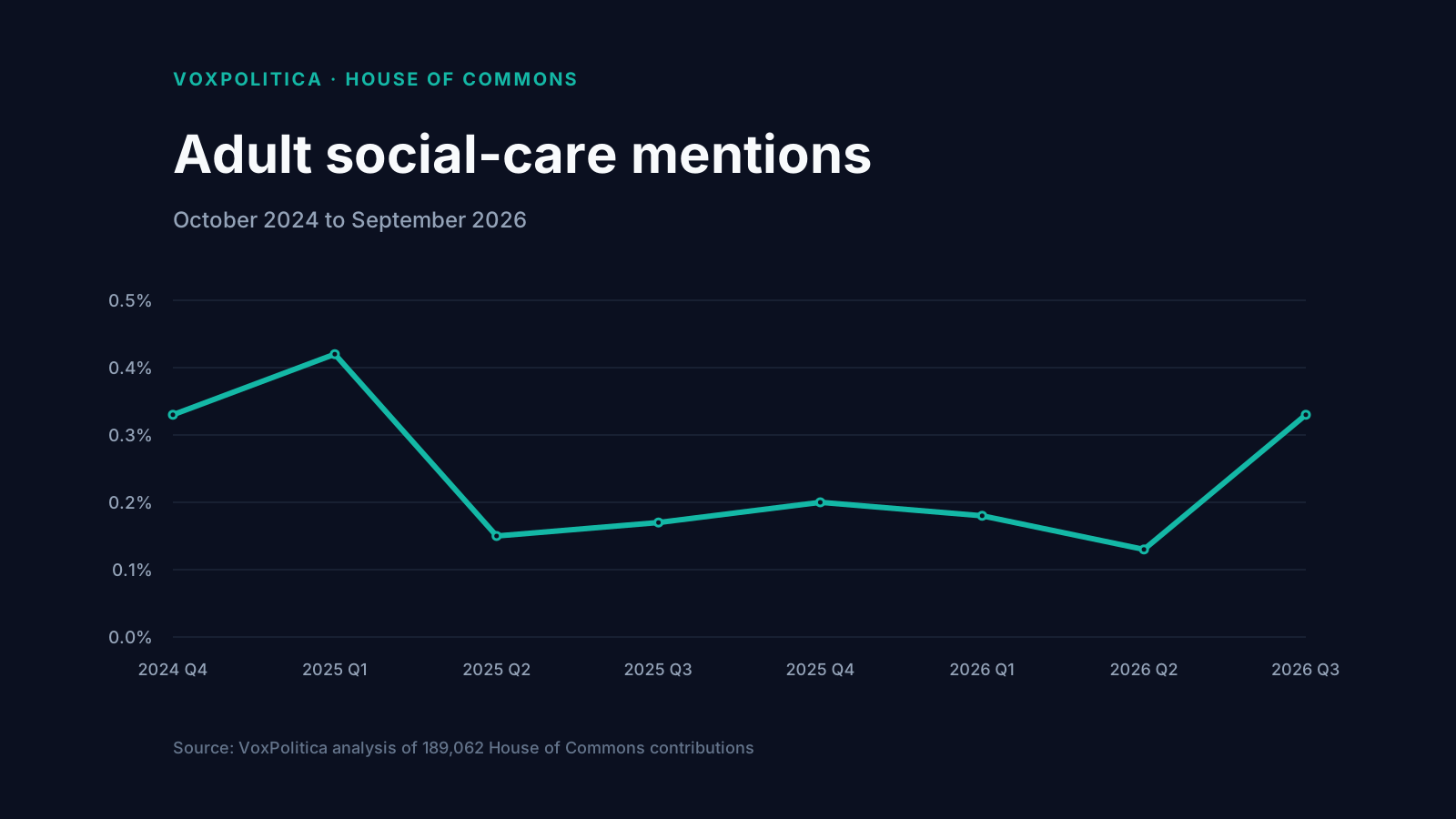
VoxPolitica found 476 Commons contributions explicitly mentioning adult social care between 5 July 2024 and 4 October 2026. The chart excludes partial endpoints and groups the frozen monthly series into full quarters. The January 2025 statement on health and adult social-care reform produced 79 contributions, 16.6% of the complete record. It explains the first-quarter peak in 2025, but it does not exhaust the argument: the subsequent record returns to councils, pay, care homes, disabled people and hospital discharge. The count measures parliamentary activity, not support for a funding model.
A firmer care offer, with disputed funding
The Government’s 29 September announcement sets out a firmer policy offer than its previous commission-led language. It defines personal care as help with tasks such as eating, bathing and using the toilet, and excludes accommodation. Ministers argue that a reformed pension uprating can keep pensions rising while redirecting some future spending growth towards care.
The proposed service would be phased, with Baroness Casey advising on delivery. The Commons Library cites Health Foundation modelling that puts the additional cost of Scottish-style free personal and nursing care for people aged 65 and over at about £6.5 billion in 2026/27, rising to about £7.5 billion in 2035/36. The announcement identifies no equivalent sum before 2030. It ties expansion to the claimed savings and to delivery capacity.
The IFS makes a stronger objection than timing alone. It argues that the reform prevents future unfunded increases in pension spending rather than creating new fiscal headroom. On that analysis, tax rises or cuts elsewhere would still be needed to pay for additional social-care spending. The IFS estimates a saving of about £4 billion a year in 2034/35, but says strong earnings growth could reduce it to zero.
“Free” applies only to the defined personal-care tasks. In Scotland, help with hygiene, meals, mobility and medication can be free while other support and residential living costs remain chargeable. The Nuffield Trust’s analysis also identifies a gap in the age limit: around 300,000 people under 65 have care and support needs. The English proposal currently covers older people and says nothing definite about their place in the future service.
Who pays, and who carries the risk
The Government’s January 2025 statement preceded the pension proposal, but MPs raised the same choices it now has to answer. Wes Streeting called for a debate about the balance of financial contribution between the individual, family and state. He defended the £880 million ringfenced for social care in the 2024 Budget, fair-pay legislation and an independent commission, while accepting that one Budget could not relieve all the pressure on the system.
Sir Edward Leigh asked whether the public had been told honestly about the affordability of the Dilnot cap. Sarah Dyke pressed for near-term action while the commission ran. Greg Smith asked how a national service, a care-pay floor and continued council delivery could be financed without higher taxes while day-to-day spending was maintained. Jeremy Corbyn asked whether a public national care service would expand public provision rather than rely on the existing private residential-care market.
Wes Streeting
Set the unresolved question as the balance of contribution between the individual, family and state.
Sir Edward Leigh
Asked whether the public had been told honestly about the affordability of the Dilnot cap.
Greg Smith
Asked how councils could maintain everyday care while delivering a National Care Service and pay floor without higher taxes.
Deirdre Costigan
Presented fair national pay, conditions, training and progression as part of the reform, not an incidental workforce measure.
Sarah Dyke
Used a constituent’s threatened care-home move to press for measures before the long-term review concluded.
Wes Streeting
Connected adaptation and community care to independence and to preventing demand on health and care services.
This was not a clean party split. Streeting left the balance between households and the state open. Conservative MPs raised fiscal and local-government constraints; Liberal Democrats pressed for faster action; Labour and independent MPs questioned delivery, ownership and access. Their disagreement was over which costs should remain with individuals and which should move to the state.
Councils and providers face the gap before 2030
The proposed offer is national, but much of its delivery would remain local. Councils assess needs, commission care and administer means-tested contributions towards care-home accommodation. Their tax bases, provider markets and rural travel costs differ. A national personal-care right could reduce variation in what the state pays for defined services, but would not set provider fees or meet the costs of accommodation and travel.
Workforce costs run through the funding argument. The January statement used 131,000 vacancies to support the case for a fair pay agreement. In October 2024, Stephen Kinnock said that agreement had to account for its effects on local government, the care market and self-funders. Better pay and training may improve recruitment and retention, but councils and providers must meet the higher cost. The Government therefore makes workforce and provider capacity a condition of expansion.
MPs and ministers also link home adaptations, community teams and care capacity to fewer avoidable admissions and delayed discharges. Any NHS saving depends on staff, providers and suitable support being available where the patient lives. For people who need care, the more immediate effects are greater independence and less uncertainty about the bill.
Earlier plans also foundered on cost and delivery
Successive reviews have supplied technical designs. The 1997 Royal Commission recommended free personal care for eligible older adults, and Scotland introduced a version of it. Labour’s 2010 plan for phased free-at-the-point-of-use care was not taken forward. The Dilnot model informed the Care Act framework for a cap, but implementation was delayed and then dropped after the 2024 election. The £86,000 cap proposed in 2021 had already been postponed.
Each design distributes costs differently. A cap limits catastrophic personal-care costs while leaving individuals to pay below it. Free personal care covers a defined package regardless of wealth but leaves other charges in place. A comprehensive service would shift more spending to general taxation; a dedicated contribution or insurance model would link some funding to income or wealth. The Government proposes free personal care for older people and says the slower path of pension spending will pay for it without borrowing. It has not published a funding profile or answered the IFS claim that tax rises or other spending cuts would still be required.
Baroness Casey’s report is due in summer 2027. Ministers will then need to define the covered care, address working-age adults and unpaid carers, fund the years before 2030 and show councils and providers how the promised service can be delivered.
VoxPolitica searched all House of Commons contributions from 5 July 2024 to 4 October 2026 through its typed Professional Filter Tool for the exact phrase “adult social care”. The complete result contained 476 contributions from 195,853 Commons contributions. The chart excludes the partial July 2024 and October 2026 endpoints and groups the frozen monthly series into calendar quarters: 465 matches from 189,062 contributions, October 2024 to September 2026. The argument register is illustrative close reading of selected Commons exchanges, not a theme-prevalence measure. Parliamentary claims were checked against linked Hansard. Policy context was checked against the Government announcement, the Commons Library’s reform briefing, the IFS analyses of the new triple lock and its ability to fund social care, and the Nuffield Trust’s analysis of personal care, current to 4 October 2026.
View chart data
Source: VoxPolitica analysis of 189,062 House of Commons contributions, 1 October 2024 to 30 September 2026. The query matched 465 contributions. Frequency measures activity in the defined record, not support for a funding model or public opinion.