When the average diesel price passed £2 a litre on 2 October, the RAC traced the pressure to conflict and disrupted trade routes far beyond Westminster. The day before, a 4% rise in Ofgem’s Great Britain price cap had taken effect. Government cannot set the world price of oil or gas. Domestic policy can influence how much of a shock reaches households and drivers, who receives additional protection and what investment is made before the next one.
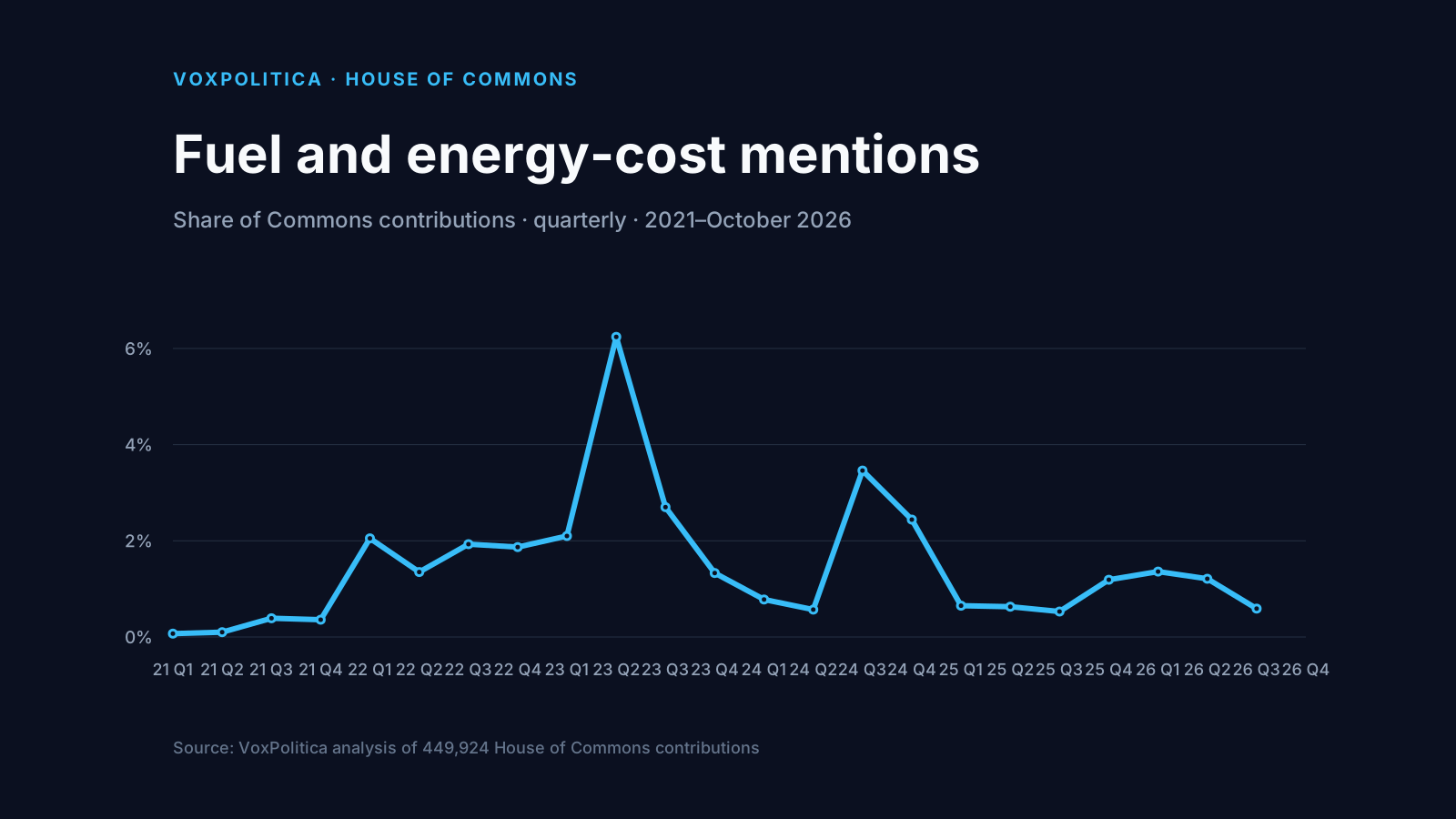
VoxPolitica found 6,385 Commons contributions between January 2021 and 4 October 2026 matching “energy bills”, “fuel prices”, “petrol prices” or “diesel prices”. Their share of Commons business rose sharply during the 2022–23 crisis, then fell back. The series measures use of those terms, not agreement or the composition of the argument.
This article was prepared by VoxPolitica Editorial using a blend of human research, VoxPolitica's databases, and an AI research agent that uses the VoxPolitica API to analyse parliamentary data. If you'd like to commission in-depth research to support your work, contact us.
View chart data
- 2021 Q1
- Full calendar quarter
- Matches11All contributions16,392Share0.07%
- 2021 Q2
- Full calendar quarter
- Matches17All contributions16,251Share0.10%
- 2021 Q3
- Full calendar quarter
- Matches62All contributions15,844Share0.39%
- 2021 Q4
- Full calendar quarter
- Matches82All contributions22,896Share0.36%
- 2022 Q1
- Full calendar quarter
- Matches510All contributions24,929Share2.05%
- 2022 Q2
- Full calendar quarter
- Matches247All contributions18,305Share1.35%
- 2022 Q3
- Full calendar quarter
- Matches206All contributions10,652Share1.93%
- 2022 Q4
- Full calendar quarter
- Matches455All contributions24,331Share1.87%
- 2023 Q1
- Full calendar quarter
- Matches491All contributions23,411Share2.10%
- 2023 Q2
- Full calendar quarter
- Matches1,208All contributions19,354Share6.24%
- 2023 Q3
- Full calendar quarter
- Matches304All contributions11,254Share2.70%
- 2023 Q4
- Full calendar quarter
- Matches207All contributions15,529Share1.33%
- 2024 Q1
- Full calendar quarter
- Matches174All contributions22,377Share0.78%
- 2024 Q2
- Full calendar quarter
- Matches71All contributions12,546Share0.57%
- 2024 Q3
- Full calendar quarter
- Matches235All contributions6,791Share3.46%
- 2024 Q4
- Full calendar quarter
- Matches629All contributions25,772Share2.44%
- 2025 Q1
- Full calendar quarter
- Matches229All contributions35,165Share0.65%
- 2025 Q2
- Full calendar quarter
- Matches183All contributions28,884Share0.63%
- 2025 Q3
- Full calendar quarter
- Matches79All contributions14,900Share0.53%
- 2025 Q4
- Full calendar quarter
- Matches287All contributions24,035Share1.19%
- 2026 Q1
- Full calendar quarter
- Matches391All contributions28,854Share1.36%
- 2026 Q2
- Full calendar quarter
- Matches237All contributions19,561Share1.21%
- 2026 Q3
- Full calendar quarter
- Matches70All contributions11,891Share0.59%
- 2026 Q4
- Partial recess-period endpoint
- Matches0All contributions0Share—
Source: VoxPolitica analysis of 449,924 House of Commons contributions, 1 January 2021–4 October 2026. The query matched 6,385 contributions. Frequency measures activity in the defined record, not agreement, importance or public concern.
Who should pay during a price shock?
In January 2022, Labour’s Ed Miliband accepted that wholesale gas prices had a global cause but blamed Britain’s exposure on supplier regulation, low gas storage and poorly insulated homes. He proposed a larger Warm Home Discount, removing VAT from bills and a one-off levy on oil and gas profits. For the longer term, he backed a large retrofit programme and more low-carbon generation. His closing speech separated the external shock from domestic policy choices.
Greg Hands, then the energy minister, divided responsibility differently. He pointed to the price cap, Warm Home Discount, Winter Fuel Payment and Household Support Fund for vulnerable consumers, while putting new nuclear, renewables and domestic gas supply at the centre of the longer-term response. He argued that storage could help a supply shortage but not a high-price crisis.
The government announced the £400 Energy Bills Support Scheme and additional payments for benefit recipients, pensioners and disabled people in May 2022. It said the new Energy Profits Levy—a temporary tax on exceptional oil and gas profits with an investment allowance—would help fund that cost-of-living package. The separate Energy Price Guarantee followed in September and took effect in October. It limited unit prices rather than each household’s total spending; the £400 discount was non-repayable.
Ed Miliband, Household Energy Bills: VAT, 11 January 2022“We help all families, and we give most to those who need it most.”
One recurring disagreement was the split between universal help, which reaches households quickly but costs more, and targeted support, which concentrates public money on those judged most exposed but can leave gaps.
At the pump, competition became a distinct domestic lever
Road fuel sharpened another point: wholesale costs are not the only price at the forecourt. When the Competition and Markets Authority published its road-fuel market study in July 2023, the then energy minister Graham Stuart accepted its findings on rising margins and the “rocket and feather” pattern for diesel. He said the government would create a statutory open-data system and a continuing monitoring function, so drivers could compare prices and the market could be scrutinised. His statement made competition, rather than oil supply alone, a government responsibility.
Other MPs thought transparency was too modest. Liberal Democrat Tim Farron called for rural fuel-duty relief to be extended, arguing that motorists without realistic public-transport alternatives faced higher prices. SNP spokesman Alan Brown questioned whether an app would help digitally excluded drivers or create competition where there were few forecourts. Labour’s Kerry McCarthy backed the CMA proposals but asked why the government had waited to act. Their interventions each questioned whether stronger competition alone would protect motorists.
Fuel Finder is now a statutory open-data scheme, and the CMA has monitoring and enforcement powers. The scheme is intended to strengthen price competition and expose retail margins and local differences more clearly. It does not set the oil price or the rate of fuel duty.
The next dispute is about exposure to future shocks
At the Great British Energy Bill’s second reading in September 2024, MPs argued over investment and future exposure. Energy Secretary Ed Miliband said a publicly owned energy company would accelerate clean energy and reduce Britain’s vulnerability to volatile fossil-fuel markets. His case linked consumer protection to public investment, supply chains and energy independence.
The Conservative opposition did not deny that reliance on gas was a problem. Andrew Bowie said it was, but argued that curtailing North Sea production would increase import dependence in the near term. He also questioned whether Great British Energy could deliver promised bill savings or justify its call on taxpayers. His speech put the trade-off plainly: the government’s programme may reduce long-run exposure, he said, but must also answer for investment, jobs, tax receipts and bills in the intervening years.
The legislation passed in 2025. Great British Energy now has statutory objects covering clean-energy production, efficiency and security of supply. The Act establishes the Government’s chosen investment vehicle. It does not settle disputes over cost, pace or whether domestic fossil-fuel production changes consumer prices.
The current mix of caps, discounts and tax
Ofgem’s October–December cap is £1,723 a year for a typical Direct Debit household on a default tariff, up 4% on the preceding period. It limits unit rates and standing charges, not a household’s final bill. The government has kept the Warm Home Discount at £150 for eligible households. Its 2025 Budget set out a staged return of fuel duty to the pre-March 2022 rate: 1p a litre from September 2026, then 2p increases in December 2026 and March 2027.
A lower duty rate gives broad relief to drivers at a cost to the Exchequer. A targeted bill discount concentrates help on low-income households. Fuel Finder addresses retail competition without replacing a tax cut. Investment in clean power or domestic production concerns future exposure; it does not cut the price at the pump immediately.
The G7 statement of 2 October promised a coordinated release of 100 million barrels over four months, with diesel brought forward in the first 20 days, alongside action on refinery capacity. Across the Commons debates examined here, MPs from different parties treated government as capable of cushioning at least part of a price shock. They disagreed over who should pay and which investments would reduce Britain’s exposure before the next one.
VoxPolitica searched all House of Commons contributions from 1 January 2021 to 4 October 2026 through its typed Professional Filter Tool for “energy bills”, “fuel prices”, “petrol prices” or “diesel prices”. The complete result contained 6,385 contributions from 449,924 Commons contributions. The chart groups the frozen monthly series into calendar quarters; it is an activity measure, not a measure of support, salience or changing belief. Quotations and parliamentary characterisations were checked against the linked Hansard contributions. Current context was checked against the RAC, Ofgem, CMA and Fuel Finder, the May 2022 support package, the fuel-duty schedule, the Great British Energy Act factsheet and the G7 statement, current to 4 October 2026.